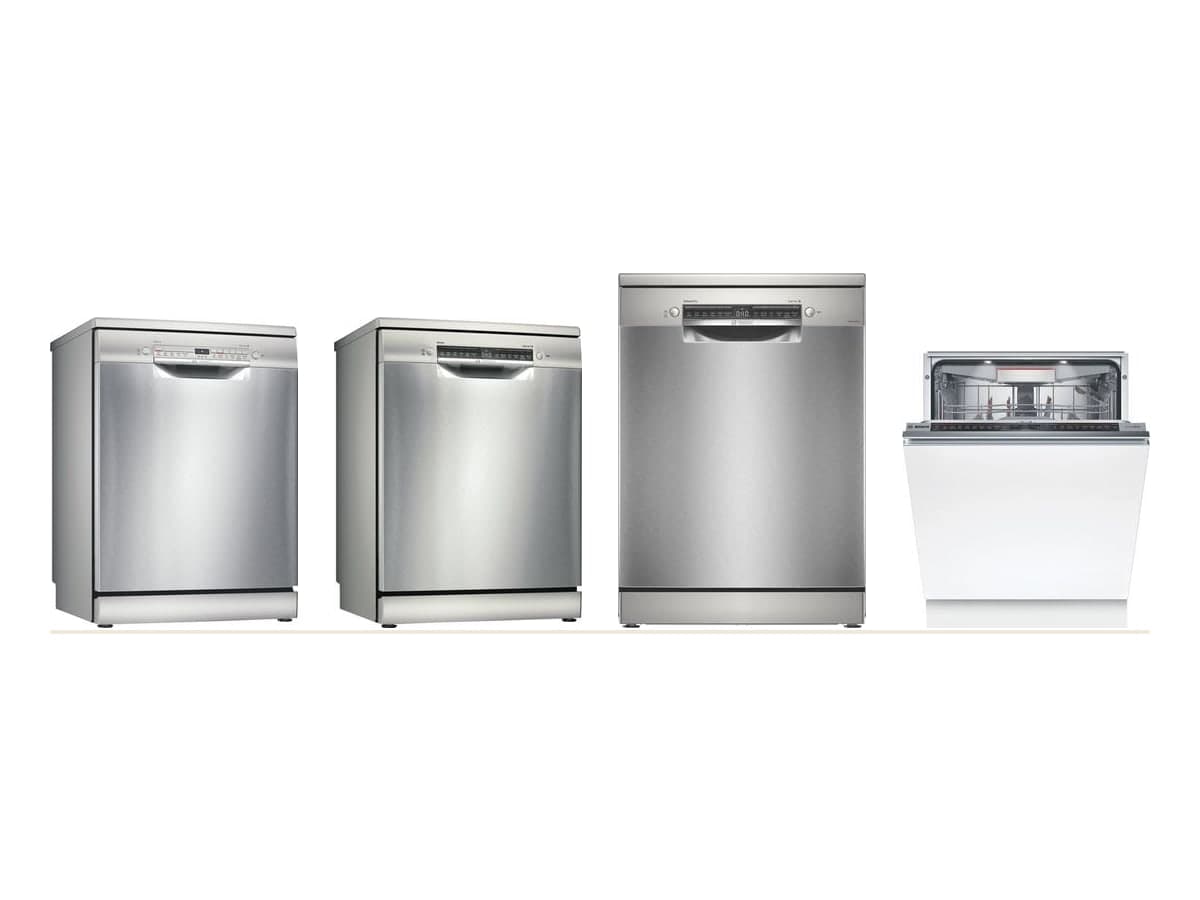
Series 4 suits most Australian kitchens: 14 place settings, 46 decibels and a four-star energy rating for around $1,000. Series 6 adds a fifteenth place setting, drops the noise to 44 decibels and cuts water use by nearly a fifth, which matters in a small flat or an open-plan kitchen. Series 2 is the budget option and Series 8 is integrated-only at nearly $2,700.
Bosch's series numbers are a feature ladder, not a quality ladder. Every one of these machines is built on the same chassis with the same AquaStop leak protection, the same two spray arms and the same two-year warranty. What changes is capacity, noise, drying and how many programs you get.
Bosch Series 2
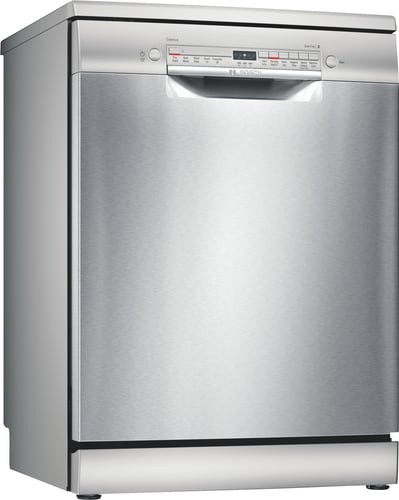
The entry machine, rated 4.6 from more than 400 reviews at The Good Guys. Thirteen place settings, five programs, 48 decibels, 3.5 energy stars and 255kWh a year.
It is the loudest and thirstiest of the four at 12.7 litres a cycle, and the top basket does not adjust for height, so tall glasses and stockpots compete for the same space.
What We Like:
- Cheapest Bosch
- AquaStop leak protection
- Rated 4.6 by owners
What We Don't Like:
- Top basket height is fixed
Bosch Series 4
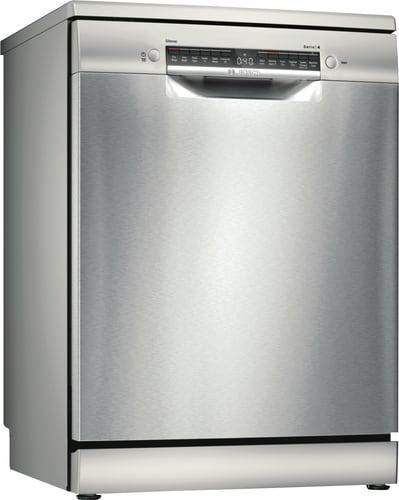
A fourteenth place setting, a sixth program, a top basket that adjusts on three levels, and folding plate racks in both baskets. Noise drops to 46 decibels and energy use to 230kWh a year, the lowest of the freestanding three. Owners rate it 4.6 from more than 400 reviews at The Good Guys.
Water use goes the wrong way: 13.5 litres a cycle against the Series 2's 12.7, because the bigger load takes more to rinse.
What We Like:
- Adjustable top basket
- Lowest running energy of the freestanding models
- Four energy stars
What We Don't Like:
- Uses more water per cycle than the Series 2
Bosch Series 6
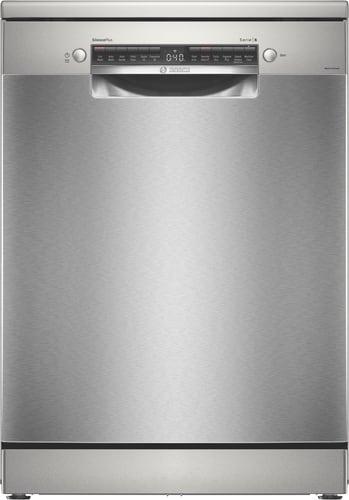
Fifteen place settings, 44 decibels, and the big one: 11 litres a cycle and a 5.5-star water rating, against 13.5 litres on the Series 4. It adds an Auto Gentle program, a heat-exchanger drying system and an LED display. Owners rate it 4.7 from 380 reviews at The Good Guys, the highest score in the range.
Annual energy is 245kWh, higher than the Series 4, because the extra drying costs power. There is also a 45cm version for narrow kitchens at about the same price as the 60cm.
What We Like:
- 11 litres a cycle, 5.5 water stars
- 44 decibels
- Rated 4.7 by owners
What We Don't Like:
- Uses more energy than the Series 4
Bosch Series 8
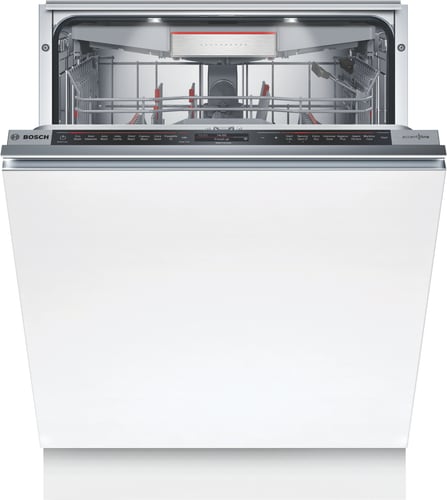
The quietest and most efficient: 42 decibels, 206kWh a year, 4.5 energy stars, eight programs, six folding racks in the top basket and eight in the bottom, plus Zeolith drying, which uses a mineral that releases heat as it absorbs moisture rather than running a heating element. Remote start over Wi-Fi.
It is fully integrated only, so it needs a cabinet door made to fit and the panel is not included. It also has no owner reviews at The Good Guys yet.
What We Like:
- 42 decibels, 206kWh a year
- Zeolith drying
- Eight programs
What We Don't Like:
- Integrated only, cabinet panel not included
Side by side
| Series 2 | Series 4 | Series 6 | Series 8 | |
|---|---|---|---|---|
| Price | $800–900 | $900–1,000 | $1,400–1,500 | $2,600–2,800 |
| Place settings | 13 | 14 | 15 | 15 |
| Noise | 48dB | 46dB | 44dB | 42dB |
| Energy rating | 3.5 stars | 4 stars | 4 stars | 4.5 stars |
| Energy use | 255kWh/yr | 230kWh/yr | 245kWh/yr | 206kWh/yr |
| Water rating (WELS) | 4 stars | 4 stars | 5.5 stars | 5 stars |
| Water per cycle | 12.7L | 13.5L | 11L | 12.2L |
| Programs | 5 | 6 | 6 | 8 |
| Top basket | Fixed | 3 heights | 3 heights | 3 heights |
| Drying | Condensation | Condensation | Heat exchanger | Zeolith |
| Type | Freestanding | Freestanding | Freestanding | Fully integrated |
| Warranty | 2 years | 2 years | 2 years | 2 years |
| Owner rating | 4.6 (419) | 4.6 (408) | 4.7 (380) | No reviews yet |
Owner ratings are from The Good Guys. Energy and water figures are the registered Australian label values.
What actually differs
Noise. 48, 46, 44, 42 decibels. Each step is about the difference between hearing the machine across an open-plan room and not noticing it. If the kitchen opens onto the living room and the dishwasher runs while you watch television, this is the spec that decides the purchase.
Water. The Series 6 uses 11 litres a cycle against the Series 4's 13.5. Over about 270 cycles a year that is roughly 675 litres saved, which matters more in a water-restricted town than the dollar difference does.
Drying. Series 2 and 4 use condensation drying, which leaves plastics damp. Series 6 adds a heat exchanger. Series 8 uses Zeolith, which is the only one of the four that reliably dries plastic containers in a normal cycle.
Capacity. 13, 14, 15, 15. A place setting is a dinner plate, side plate, bowl, glass, cup, saucer and cutlery, so one more setting is one more person's dinner, not a lot more room for baking trays.
What doesn't change: AquaStop leak protection, two spray arms across five zones, a 60cm cabinet, 845mm height and a two-year warranty run right through the range.
FAQs
Is a Bosch Series 6 quieter than a Series 4 in practice?
By two decibels on the label, which is a small but audible difference. Owner reviews of both describe them as quiet; the complaints about noise cluster on the Series 2 at 48 decibels.
Why does the Series 6 use more energy than the Series 4?
The Series 6 runs a heat-exchanger drying stage that the Series 4 does not, and heating is where a dishwasher spends its power. It gives back more than it costs on water.
Can I get a Series 8 as a freestanding machine?
Not in Australia. The current Series 8 dishwashers are fully integrated or semi-integrated, which means a joiner-made cabinet door. The freestanding range stops at Series 6.
Does Bosch make a 45cm dishwasher?
Yes, in Series 6. It takes fewer place settings than the 60cm but has the same programs, and it costs about the same, because narrow machines are a smaller production run.