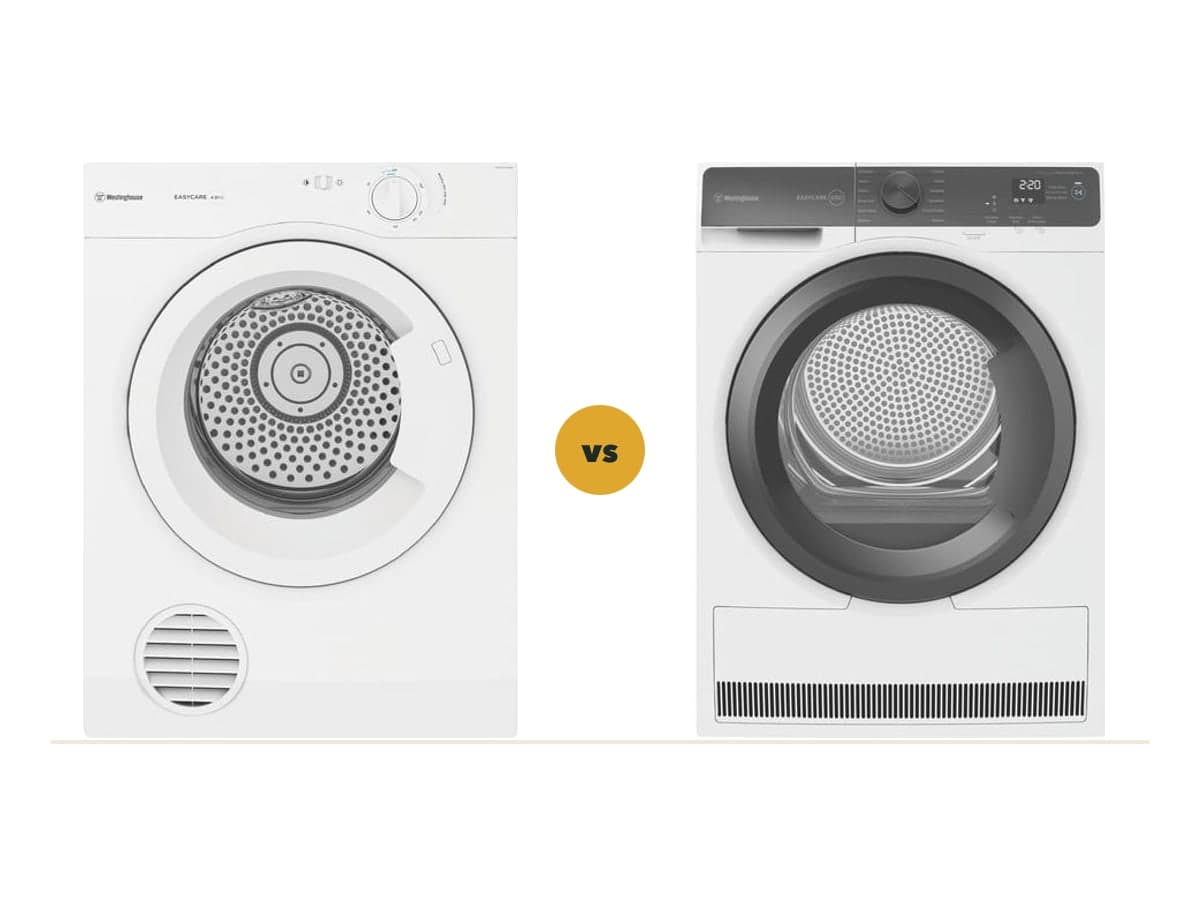
A heat pump dryer costs two to three times what a vented dryer costs and uses roughly a third of the power, so it pays for itself in a household that dries several loads a week and never pays for itself in one that dries a few a year. A vented dryer is cheap, fast and simple, but it pumps hot wet air into the room it stands in.
The third option, the condenser dryer, has effectively disappeared. The Good Guys currently lists no plain condenser dryers at all: the range is vented at the bottom and heat pump above it. A heat pump dryer is a condenser dryer with a more efficient way of removing the heat, so if you have been told to look for a condenser, a heat pump is what you are actually shopping for.
Vented dryers
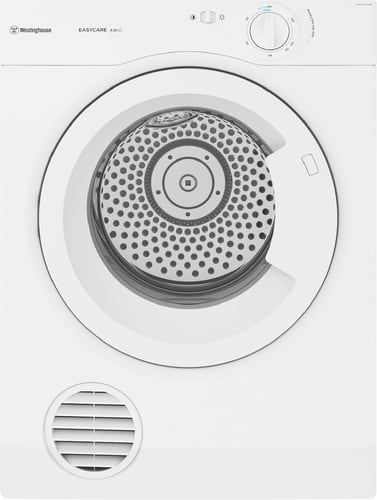
Air is heated, blown through the clothes, and the hot damp air is pushed out of the machine. Westinghouse's 4.5kg is one of the two best-selling dryers in the country, with 4.6 stars from more than 800 owners at The Good Guys. Fisher & Paykel's 7kg sensor dryer sits alongside it at 4.6 from nearly 800.
The moisture has to go somewhere. Without a duct to outside, it ends up on the laundry walls and windows, which in a closed room means condensation and eventually mould. Vented dryers also need a lint filter cleaned every load.
What We Like:
- Cheapest to buy
- Fast cycles
- Simple, few parts to fail
What We Don't Like:
- Dumps hot moist air into the room unless ducted
Heat pump dryers
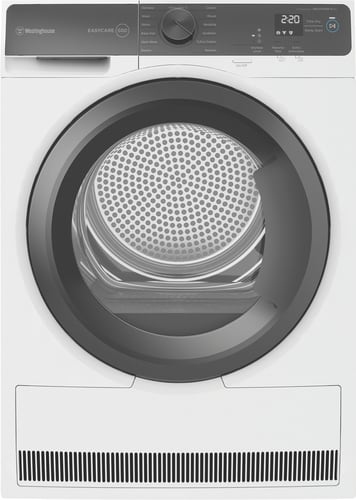
A heat pump recycles its own heat rather than making it fresh each time, so it runs far cooler and uses roughly a third of the electricity. Nothing is vented: water collects in a tank you empty or plumbs into the drain. Westinghouse's 8kg is the volume seller at around $1,000 with 4.2 stars from more than 160 owners; Hisense's 8kg is $899 with 4.8 from more than 120; Bosch's 8kg is around $1,550 with 4.7 from nearly 50.
Cycles run longer because the air is cooler, and there is a second filter, the condenser filter, that needs rinsing periodically. Owner complaints across brands cluster on cycle length and on that filter.
What We Like:
- About a third of the running cost
- No venting needed
- Gentler on fabrics
What We Don't Like:
- Longer cycles and a second filter to clean
What each type is good at
| Vented | Heat pump | |
|---|---|---|
| Running cost | Highest | Lowest, roughly a third |
| Purchase price | $240–$510 | $900–$2,100 |
| Needs an outside vent or open window | Yes | No |
| Puts moisture into the room | Yes | No |
| Drying time | Faster | Slower |
| Drying temperature | Hot | Low, gentler on fabric |
| Filter and tank maintenance | Lint filter | Lint filter plus a water tank or drain hose |
| Suits | Occasional use, a low purchase price | Frequent use, a room with no vent |
Side by side
| Vented | Heat pump | Condenser | |
|---|---|---|---|
| Typical price | $350–400 | $900–1,000 | Not currently stocked |
| Running cost per load | Highest | About a third of vented | Between the two |
| Where the moisture goes | Into the room, or out a duct | Into a tank or the drain | Into a tank or the drain |
| Needs a vent or window | Yes | No | No |
| Cycle time | Fastest | Longest | Medium |
| Heat on fabrics | Hottest | Coolest | Hot |
| Filters to clean | Lint | Lint and condenser | Lint and condenser |
| Wall mountable | Many models | Some models | — |
| Typical capacity | 4.5–7kg | 8–10kg | — |
Which one suits you
A vented dryer suits a household that dries occasionally, a laundry with an external wall or window to duct through, a rental where the dryer comes and goes with you, and anyone whose budget stops at a few hundred dollars.
A heat pump dryer suits a household drying several loads a week, an internal laundry or cupboard with nowhere to vent, an apartment, and anyone drying wool or synthetics that a hot vented dryer shrinks or pills.
The rough arithmetic: a vented dryer uses in the order of 3 to 4kWh per full load and a heat pump around 1 to 1.5kWh. At 32 cents a kilowatt hour and five loads a week, that difference is roughly $200 a year, so a $600 price gap takes about three years to recover. Dry two loads a week and it takes seven or eight. EveryModel lists every heat pump dryer with its labelled yearly energy use, so the sum can be run on a specific model.
Where the condenser dryer went
Condenser dryers cool the moist air against a heat exchanger and collect the water, which solves the venting problem but not the energy problem. Once heat pump technology came down in price, the condenser had nothing left to offer: same tank, same filters, much higher running cost. Australian retailers have largely dropped them, and Bosch, Westinghouse, Electrolux, LG, Haier and Hisense all now sell heat pump models where a condenser used to sit.
If you find a condenser dryer on clearance, it is not a bad machine. It is simply a heat pump dryer's running cost with none of a vented dryer's price advantage.
FAQs
Can I put a heat pump dryer in a cupboard?
Yes, and that is a large part of why people buy them. It still needs airflow around the machine, so follow the clearances in the manual, but there is no duct and no hot wet air to remove.
Do heat pump dryers actually dry properly?
Yes. They run at a lower temperature for longer and finish with the same dryness settings as any other dryer. The complaint is time, not results.
Is a wall-mounted dryer possible with a heat pump?
Some heat pump models can be wall mounted and many cannot, because they are considerably heavier than a vented dryer. Check the specific model's bracket rating before planning the laundry around it.
Which dryer is best for wool and activewear?
A heat pump, by a clear margin. The lower operating temperature is easier on elastane, wool and technical fabrics that a vented dryer's heat degrades.