Most home pools in Australia are kept safe with chlorine. The difference between a salt pool and a chlorine pool is where the chlorine comes from: a salt chlorinator makes it from salt dissolved in the water, while a chlorine pool is dosed by hand with liquid, granular or tablet chlorine. In Western Australia salt chlorination is the most common method for home pools, according to HealthyWA. A mineral pool uses the same kind of chlorinator, run on a magnesium and potassium blend instead of salt, such as Zodiac's MagnaPool.
| Salt chlorinator | Hand-dosed chlorine | Mineral chlorinator | |
|---|---|---|---|
| Where the chlorine comes from | Made from salt by a cell in the plumbing | Liquid, granules or tablets added by hand | Made from a magnesium and potassium blend by the same kind of cell |
| Salt in the water | 3,000 to 6,000 ppm, by model | None added | About 4,000 ppm on Zodiac's MagnaPool system |
| Equipment to buy | A chlorinator | A test kit | A chlorinator |
| Main ongoing costs | Salt top-ups and a new cell every few years | Chlorine, bought through the season | Mineral top-ups and a new cell every few years |
| Chemicals to store | pH chemicals, some chlorine for heavy use | Chlorine and pH chemicals | pH chemicals, some chlorine for heavy use |
| Still needs | pH and chlorine tests, stabiliser outdoors | pH and chlorine tests, stabiliser outdoors | pH and chlorine tests, stabiliser outdoors |
Salt levels are from the makers' pages linked below. Checked on 28 September 2026.
How a salt chlorinator works
Pool water runs through a cell where an electric current splits the dissolved salt. Chlorine forms at one plate and dissolves straight away into hypochlorous acid, the same disinfectant that liquid chlorine produces, according to NSW Health's pool guidance. The cell reverses its polarity from time to time to limit scale on the plates, and the makers say the chlorine turns back into salt once it has done its work.
The output has a ceiling. HealthyWA warns that some home chlorinators can't keep up when a pool is used heavily or in hot weather, and that a salt pool then needs checking more often and extra chlorine added.
Salt levels. Makers set their chlorinators for different amounts of salt: Zodiac and AstralPool recommend 4,000 ppm for their current models, Davey 3,000 to 6,000 ppm, and Clark Rubber's Filtrite CE25 6,000 ppm. Seawater is about 35,000 ppm. Salt isn't used up by the chlorinator, but it's lost through splashing and backwashing and has to be topped up.
Cell life. A cell wears out as its coating is used up. AstralPool says a cell lasts about three to five years depending on use, and Zodiac puts most cells at 10,000 to 20,000 hours of running. Running a chlorinator short of salt damages the cell, according to Davey. AstralPool's warranty covers its Viron chlorinators for three years, and excludes damage from scale or corrosion if the water was kept outside its pH and chlorine range.
Chlorine and pH targets are the same for both
The water needs the same free chlorine and pH whichever way the chlorine arrives. For outdoor pools with stabiliser, HealthyWA sets a minimum of 2 mg/L of free chlorine when the water is below 26°C and 3 mg/L above it, and a pH between 7.2 and 7.8, with 7.5 ideal. Victoria's Better Health Channel advises checking pH and chlorine daily.
Stabiliser (cyanuric acid) protects chlorine from sunlight, which can destroy about 35% of free chlorine an hour, according to a NSW Health fact sheet. HealthyWA recommends keeping it between 30 and 50 mg/L. Salt pools need it too: Davey's chlorinator manual says a chlorinator may have to run up to three times as long without it.
Storing and handling chemicals
A hand-dosed pool means keeping chlorine and pH chemicals at home, and a salt pool still needs chemicals to correct its pH. HealthyWA's storage advice is to keep pool chemicals cool, dry and locked away from children, never to store them with acids, and never to mix them. Chlorine and acid make toxic chlorine gas when they meet, as a WorkSafe Victoria alert about a pool dosing fault describes. The Poisons Information Centre is on 13 11 26.
Salt, sandstone and the garden
Salt crystallising in porous stone can break it down over time. The NSW Heritage Council's guide to salt attack explains that repeated wetting and drying drives the damage, and that sandstone and limestone are far more porous than granite, bluestone or slate. Gosford Quarries, which supplies sandstone coping, says sandstone can be used around a salt pool if it is sealed, and that installers should pre-seal coping and anything within a 3m splash zone.
Backwash water from a salt pool is salty too. South Australia's EPA advises that salt pool water used on the garden needs salt-tolerant plants and an occasional watering with fresh water, in a sheet reproduced by Yorke Peninsula Council. Where backwash may go at all depends on the water authority: Sydney Water directs chlorinated pool water to the sewer, while Western Australia's Water Corporation doesn't accept home pool backwash into the sewer at all.
What each costs
The costs that are easy to price are the chlorinator itself, from about $1,700 for Clark Rubber's cheapest, and a replacement cell every few years, which costs several hundred dollars to about $1,500 depending on the model. A hand-dosed pool avoids both but needs chlorine bought through the season, and a salt pool may still need some in hot weather.
Two chlorinators
Filtrite CE25
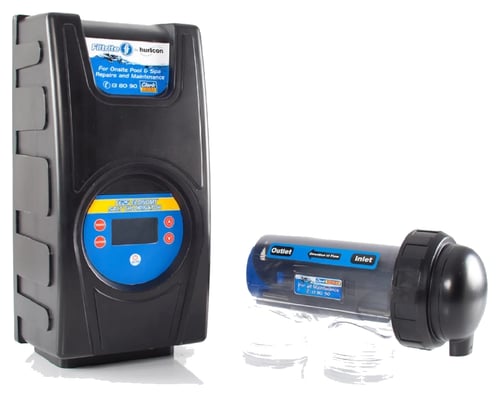
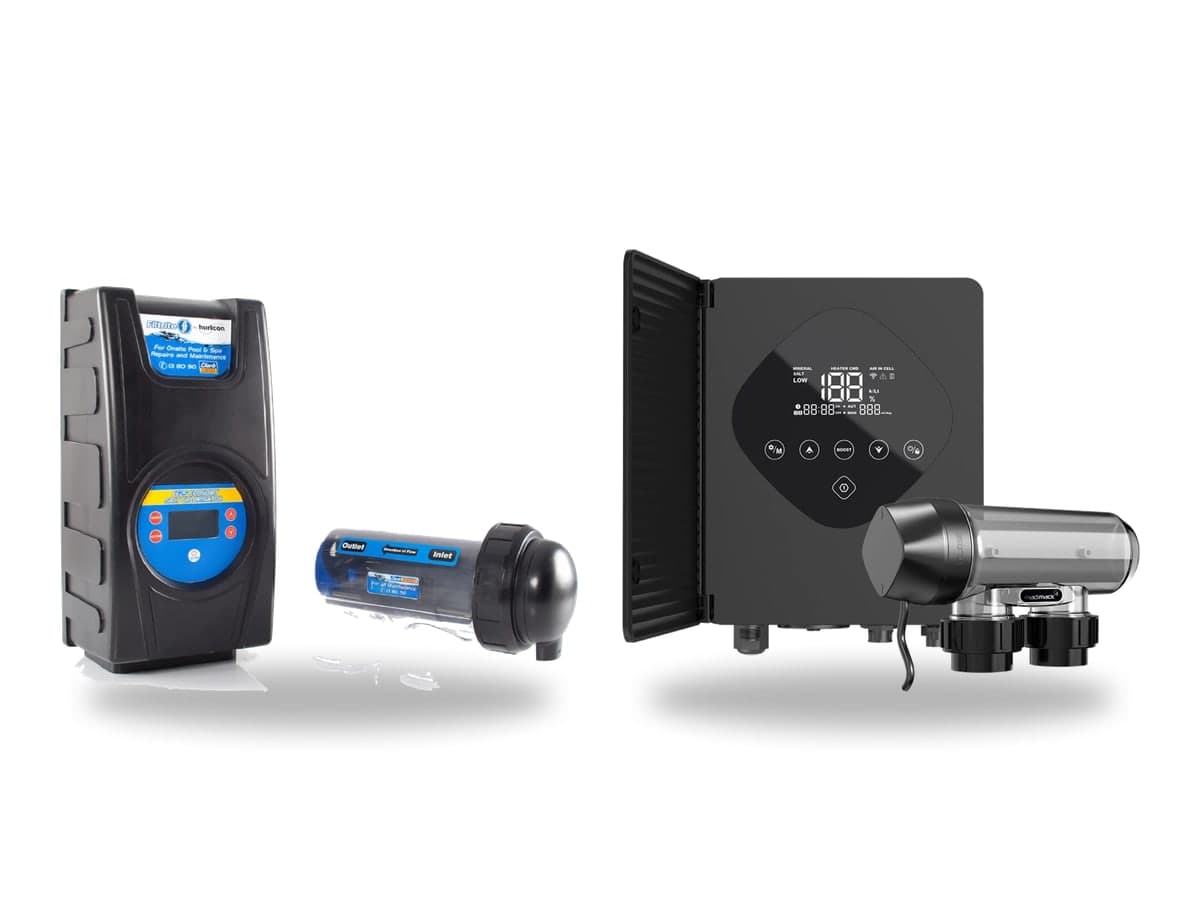
The CE25 is a Filtrite chlorinator sold only by Clark Rubber. It makes up to 25 grams of chlorine an hour and suits pools up to 96,000 litres. It has a self-cleaning cell that reverses polarity, a timer with two running periods a day, and a two-year warranty. It runs at 6,000 ppm of salt, and Clark Rubber sells replacement cells for it.
What We Like:
- Pools up to 96,000L
- Self-cleaning cell
- Replacement cells sold
What We Don't Like:
- 2-year warranty
Madimack InverCHLOR 30
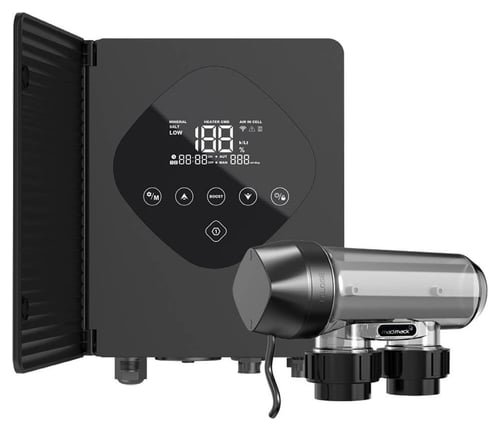
Madimack's InverCHLOR runs on salt or a mineral blend at anywhere from 1,200 to 6,000 ppm, has a self-cleaning cell rated for more than 10,000 hours, and can be controlled from a phone over wifi. Pool Shop Australia lists it as a retrofit for AstralPool E, VX, V, eQ and Halo cells, with a four-year replacement warranty on its main parts.
It costs more than the CE25, and its optional pH doser is extra.
What We Like:
- Salt or mineral
- Low-salt operation
- 4-year warranty
What We Don't Like:
- pH doser costs extra
FAQs
Is a salt water pool chlorine-free?
No. The chlorinator makes chlorine from the salt, and NSW Health describes it forming the same disinfectant, hypochlorous acid, that liquid chlorine does.
Does a salt pool taste salty?
Faintly. At 4,000 ppm it is roughly a ninth as salty as seawater. Waterco, which makes chlorinators, puts the level at which people taste salt at about 3,500 ppm.
Can a chlorine pool be converted to salt?
Yes. A chlorinator's cell is plumbed into the return line after the filter, and after any heater so the chlorine it makes doesn't reach the heater, according to Waterco's chlorinator manual. Salt is then added to the level the maker specifies.