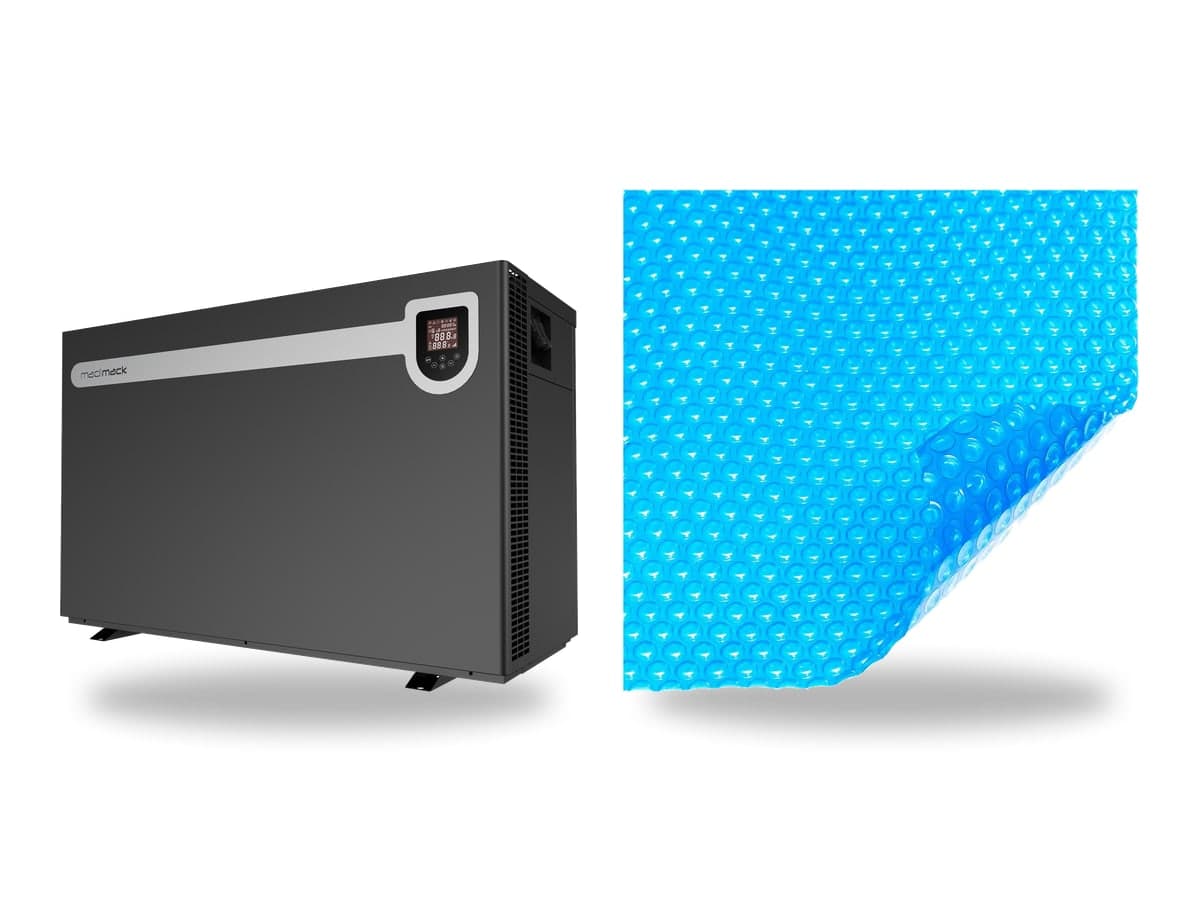
An unheated outdoor pool in southern Australia is warm enough to swim in for only part of the year, and a heater stretches that out. The three ways to heat one work very differently: solar pumps pool water through collectors on the roof, a heat pump draws heat out of the air using electricity, and a gas heater burns natural gas or LPG. NSW's planning rules call solar the most efficient way to heat a pool. Whichever heater is used, a cover keeps the heat in.
| Heat pump | Solar | Gas | |
|---|---|---|---|
| Heat from | The air, using electricity | The sun, through roof collectors | Burning natural gas or LPG |
| Energy cost per gigajoule of heat | $10.07 | Free, apart from pumping | $20.59 |
| Heating speed | Sized to add 0.2 to 0.25°C an hour | Depends on the weather | 15°C in 24 hours on a 40m² pool (Raypak 200) |
| Works when | Air down to -15°C or -20°C on some models | The sun is out | Any time |
| Longest maker warranty | 25 years on the heat exchanger | 25 years, partly pro rata | 3 years on parts |
| Example | Madimack InverELITE V4 10kW, $3,500–4,000 | Installed to quote | Installed to quote |
Energy costs are from the NSW Government's 2019 guide for aquatic centres, at 2019 commercial prices, so they show how the three rank rather than what a home will pay. Heating speeds are from Madimack's sizing advice and Rheem's Raypak brochure, and warranties from the makers linked below. Checked on 28 September 2026.
Heat pumps
A heat pump works like a reverse-cycle air conditioner, moving heat from the outside air into the pool water. Its efficiency is its coefficient of performance (COP), the heat it delivers for each unit of electricity, as AstralPool explains. The NSW guide ranks electric heat pumps as the most energy-efficient heater, at about half the energy cost of gas per unit of heat.
Makers quote COP at two test points, warm and cool, and as a range. Madimack's InverELITE V4 10kW is rated 19.5 to 7.0 with the air at 27°C, and 7.6 to 5.1 with the air at 15°C and the water at 26°C. Davey's AquaTherm 9kW is 12.6 to 6.9 in the warm test and 6.8 to 4.9 in the cool one. The headline figures of 13 to 22 come from the top of the warm range. With the air at 15°C, most of these machines deliver roughly four to eight times the energy they use.
An inverter heat pump varies its speed to match the heat the pool needs, which AstralPool says makes it quieter and more efficient than a fixed-output one. Davey rates its 9kW AquaTherm for pools of 20 to 40 cubic metres and its 12.5kW for 30 to 50, assuming an insulating cover is used in summer.
Madimack InverELITE V4
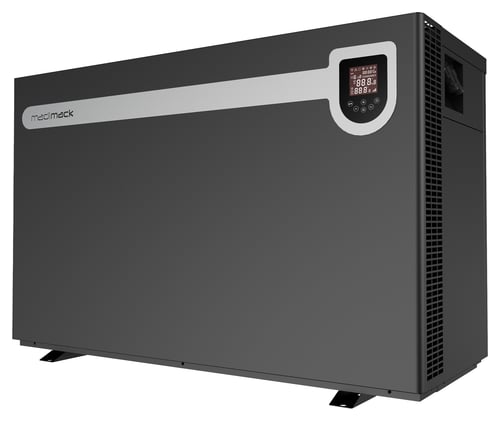
Madimack's InverELITE V4 inverter range runs from 10kW to 41kW. The 10kW delivers 9.8kW in the warm test and 6.8kW in the cool one, runs in air from -20°C to 43°C, and uses R32 refrigerant. Madimack's product page gives seven years on all parts, 15 on the compressor and 25 on the heat exchanger, though its own blog post on the V4 says ten on the compressor.
Madimack doesn't publish a pool volume for each size and sends buyers to its sizing calculator.
What We Like:
- COP 7.6 to 5.1 at 15°C
- 25 years on the heat exchanger
- Runs down to -20°C
What We Don't Like:
- No pool size published
Solar
Solar heating pumps pool water through black collectors, usually on the roof, where the sun warms it. BASIX rates it the most efficient option. The NSW guide notes that solar can't be the only heat source for a pool that must stay warm, because it depends on the weather and the season.
The collectors need space. SPASA, the pool industry association, recommends collectors covering at least 80% of the pool's surface area, ideally on a north-facing roof, and says solar can add up to four months of swimming. Warranties are long: Magen eco-Energy, which makes Heliocol collectors, covers its parts for 12 years and then pro rata to 25.
Gas
A gas heater heats the water fastest of the three. Rheem's Australian-made Raypak brochure rates its 200 model to raise a 40 square metre pool by 15°C in 24 hours, in light wind at 1.3m deep. By our sum from the brochure's input and output figures, the residential Raypaks turn about 80% of the gas's energy into heat. The NSW guide puts gas at about twice a heat pump's energy cost per unit of heat, and Rheem covers residential Raypaks for three years on parts.
Victoria is restricting new gas heaters. From 1 March 2027, Victorian regulations stop a plumber from connecting a new gas water heater to reticulated gas for an existing pool at a house or apartment building, or replacing an old one with another. There are exemptions, including where there isn't space for an electric heater, where going electric would need a switchboard upgrade, and for replacements under warranty.
Pool covers
Most of a heated pool's heat escapes through evaporation, the NSW guide says, and a cover reduces it. A properly fitted cover can stop up to 97% of evaporation, according to the Queensland Government, and Water Corporation in Western Australia says an uncovered pool loses about 45,000 litres a year and that a cover reduces the energy needed to heat it. Davey sizes its heat pumps on the assumption that the pool is covered.
Daisy 500 micron solar cover
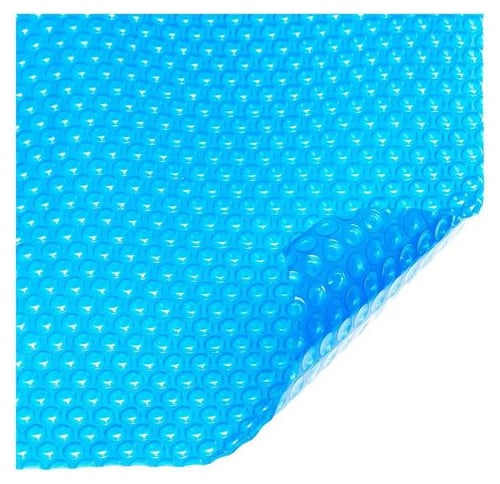
Daisy's bubble covers are made in Australia and sold at Bunnings in fixed sizes, supplied oversize to be trimmed on site. The one linked is 8m by 3m in the thicker 500 micron film. Bunnings lists sizes from 2.4m square to 15m by 5m, in 300 and 500 micron.
A cover has to come off before every swim, and a roller to wind it on is sold separately.
What We Like:
- Made in Australia
- Cut to fit on site
- 500 micron film
What We Don't Like:
- Roller costs extra
Which suits which pool
A heat pump suits a pool that needs heat through spring and autumn, whatever the weather.
Solar suits a house with a large north-facing roof and owners happy to swim when the weather has been sunny.
Gas suits a pool or spa that needs heating quickly and only occasionally, outside Victoria's rule or before it starts.
FAQs
Which pool heater is cheapest to run?
Solar, then a heat pump. The NSW guide puts the energy cost of a heat pump at about half that of gas per unit of heat, and solar's energy as free apart from the pumping.
Are there rebates for pool heating?
Not in the ACT, Victorian or NSW schemes. The ACT's Sustainable Household Scheme and Solar Victoria's hot water rebate don't list pool heaters, and NSW's Energy Savings Scheme covers pool pumps rather than heaters.
Is my old AstralPool gas heater affected by a recall?
AstralPool has recalled some HiNRG, ICI and Viron eVo gas heaters made between 2011 and 2020, because moisture can reach the ignition module and, in some cases, start a fire. Its recall page lists the models and dates; its JX and HX heaters and Zodiac's JXi are not affected.