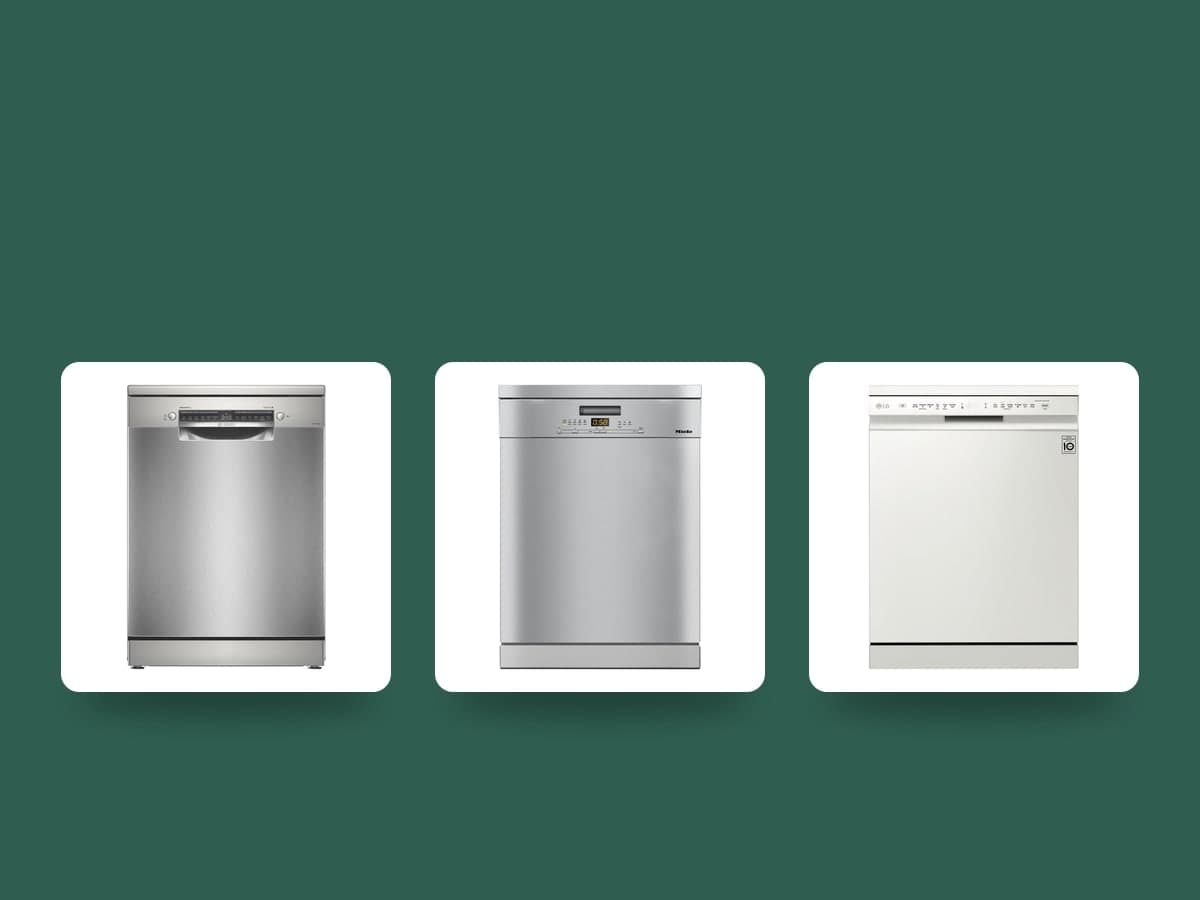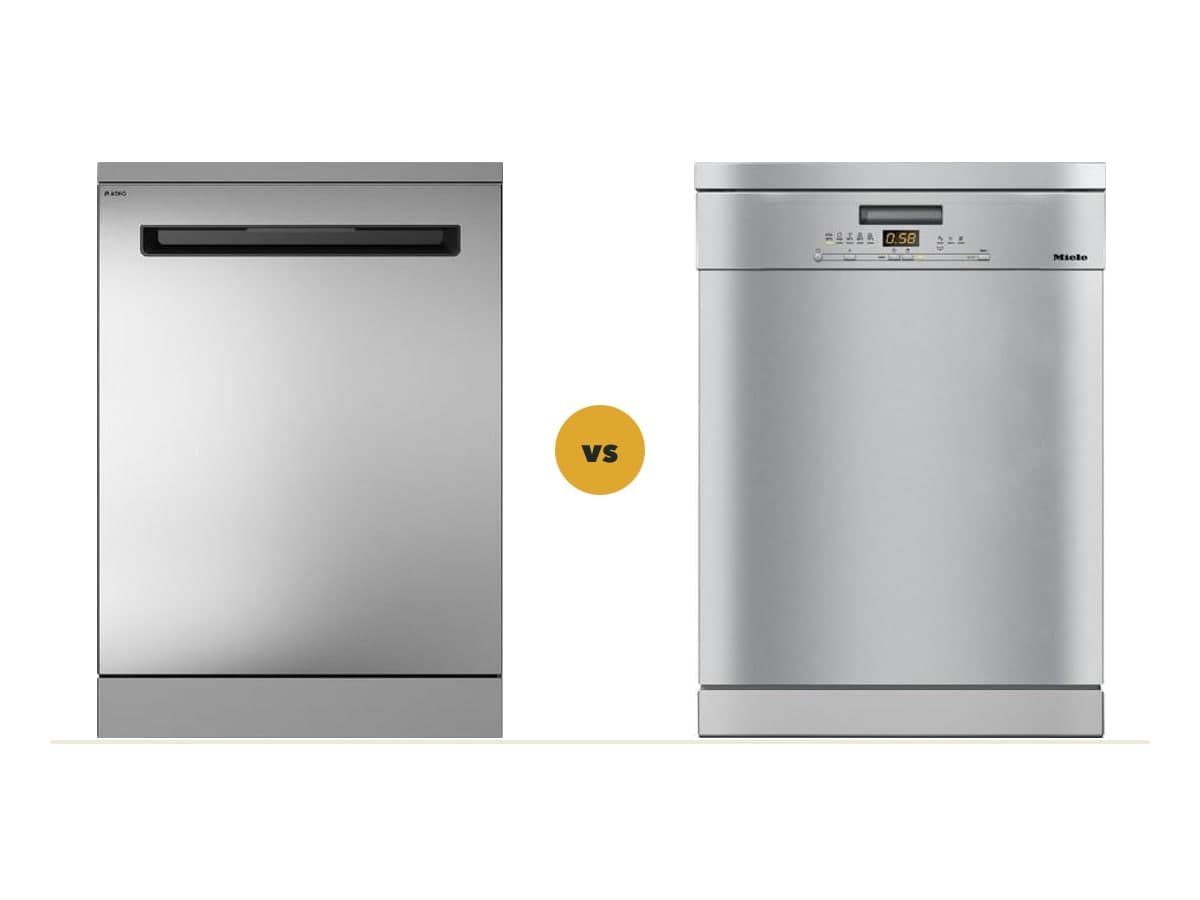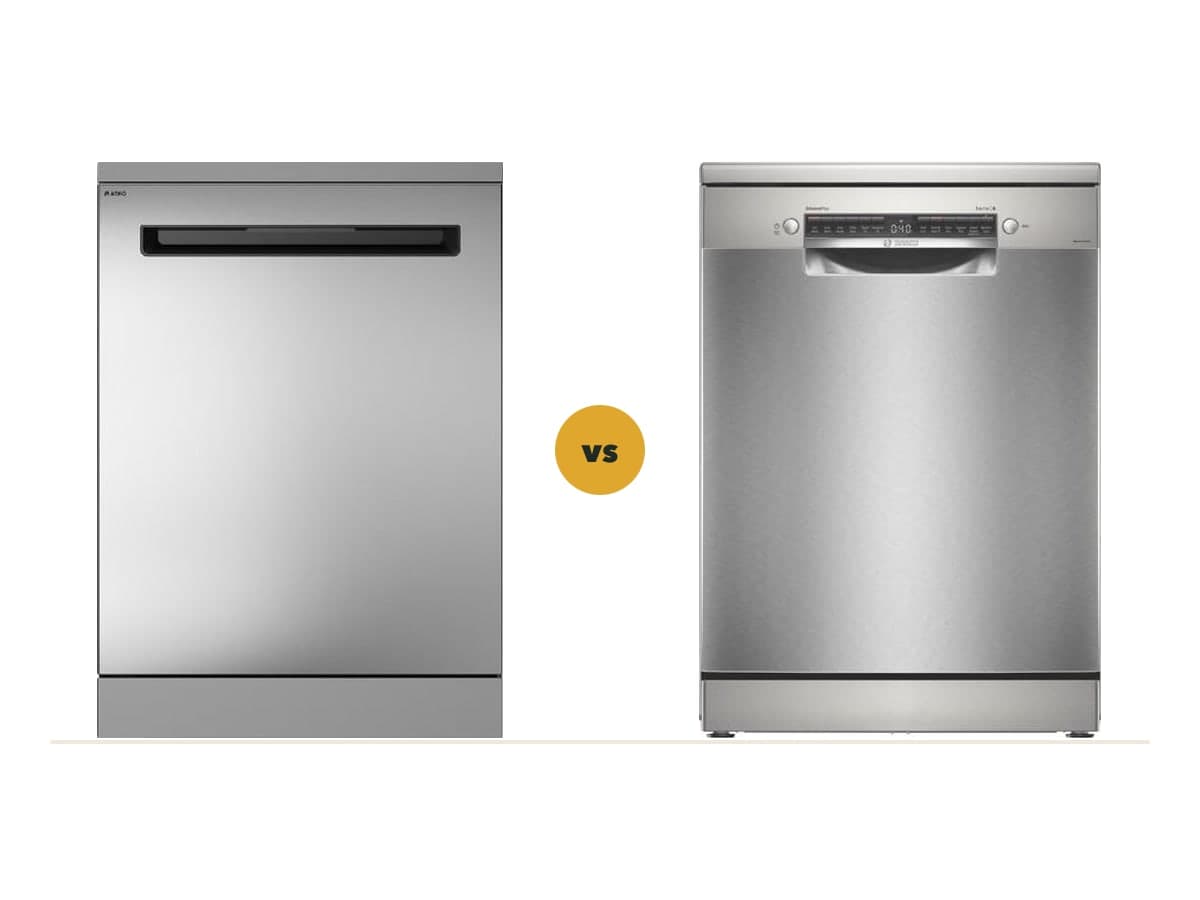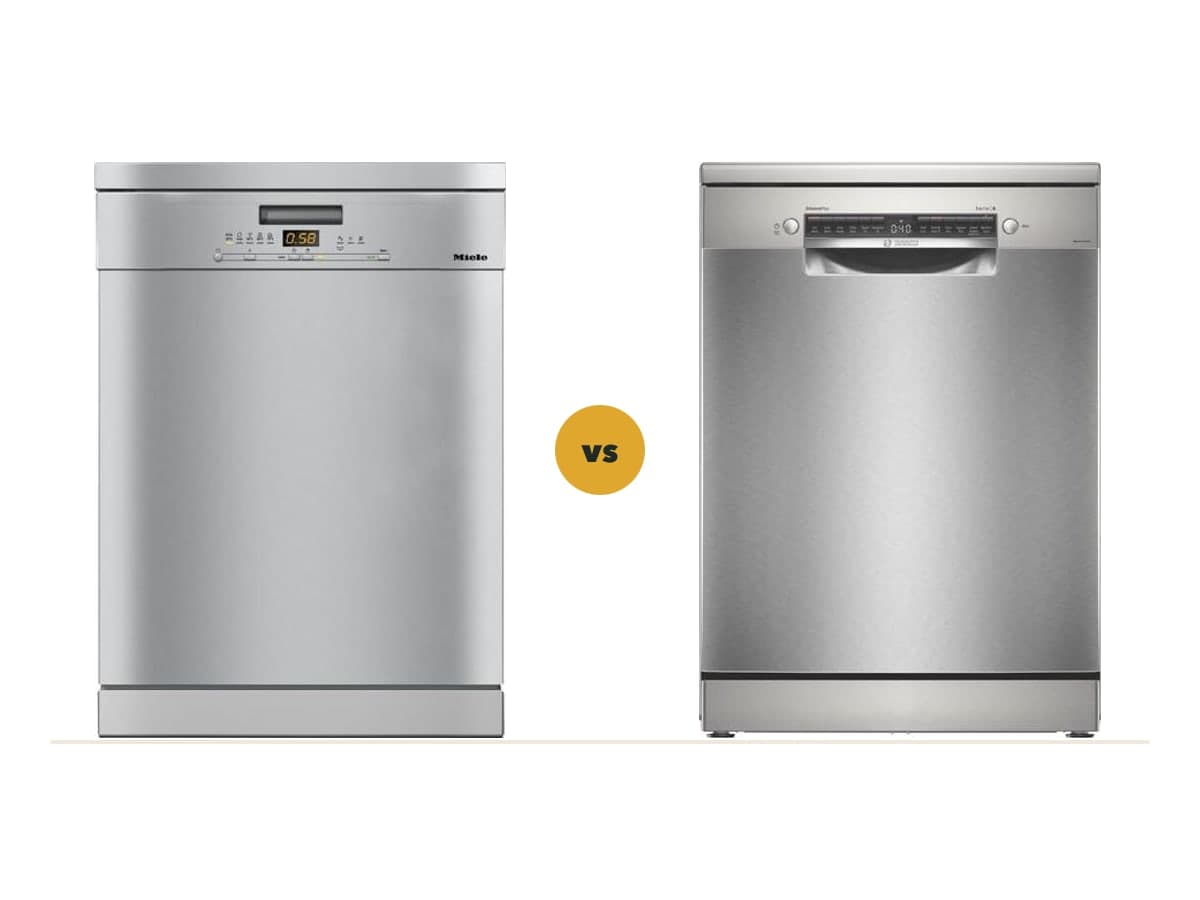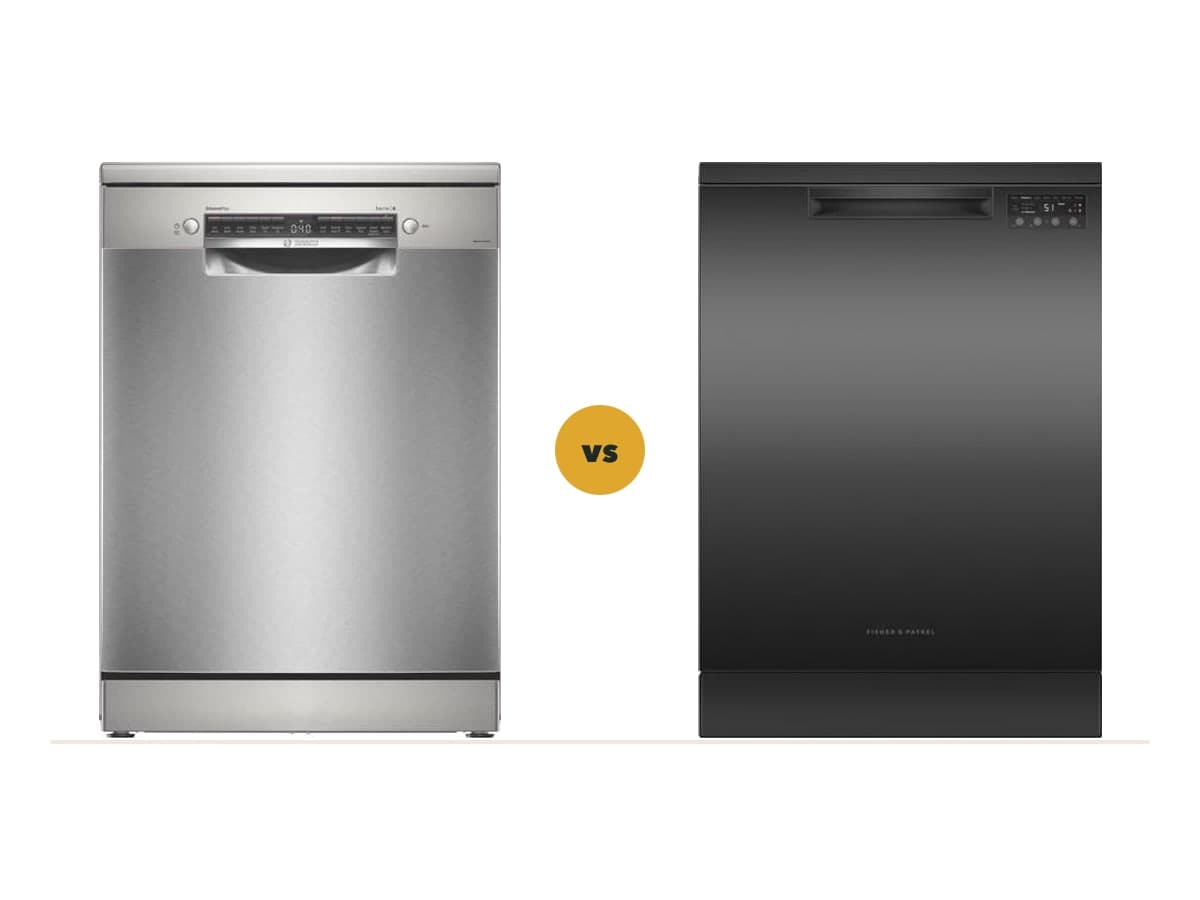
Fisher & Paykel gives you more machine for the money. Fifteen place settings start at around $999 with the Series 5. Bosch's cheapest fifteen-place machine is about $1,500. The Series 7 runs at 42 decibels and 206kWh a year for around $1,300, and the only Bosch that matches both figures is the Series 8, which costs more than twice as much.
Bosch answers with a cabinet 50mm shorter, a much larger service network, lifetime leak protection, and four rungs to choose from instead of two. Every Bosch dishwasher here stands 845mm high; every freestanding Fisher & Paykel stands 895mm. Australian benchtops sit at about 900mm, so under a fixed cabinet the Bosch has 55mm of room to spare and the Fisher & Paykel has almost none.
Fisher & Paykel also makes something Bosch does not: the DishDrawer, a dishwasher in a drawer that runs half loads without half-filling a big machine.
The two ranges at a glance
| Places | Noise | Energy | kWh/yr | Water | L/cycle | Height | Price | |
|---|---|---|---|---|---|---|---|---|
| Bosch | ||||||||
| Series 2 SMS2ITI02A | 13 | 48dB | 3.5 stars | 255 | 4 stars | 12.7 | 845mm | $800–900 |
| Series 4 SMS4HVI01A | 14 | 46dB | 4 stars | 230 | 4 stars | 13.5 | 845mm | $900–1,000 |
| Series 6 SMS6HAI02A | 14 | 44dB | 4 stars | 230 | 5 stars | 11.4 | 845mm | $1,300–1,400 |
| Series 6 SMS6HCI02A | 15 | 44dB | 4 stars | 245 | 5.5 stars | 11 | 845mm | $1,400–1,500 |
| Series 8 SBT8ZC801A | 15 | 42dB | 4.5 stars | 206 | 5 stars | 12.2 | 865mm | $2,600–2,800 |
| Fisher & Paykel | ||||||||
| Series 5 DW60FC1X3 | 15 | 48dB | 3.5 stars | 295 | 5 stars | 12.2 | 895mm | $900–1,000 |
| Series 7 DW60FC4B2 | 15 | 42dB | 4.5 stars | 206 | 5.5 stars | 11.1 | 895mm | $1,200–1,300 |
| Series 7 DishDrawer | 7 | 43dB | 3.5 stars | 134 | 4.5 stars | 6.9 | 410mm | $1,400–1,600 |
Figures are from the energy and water rating labels, which are government schemes, and from The Good Guys listings. Bosch also sells a 45cm Series 6 at 10 place settings for buyers short on width.
How the Bosch range is built
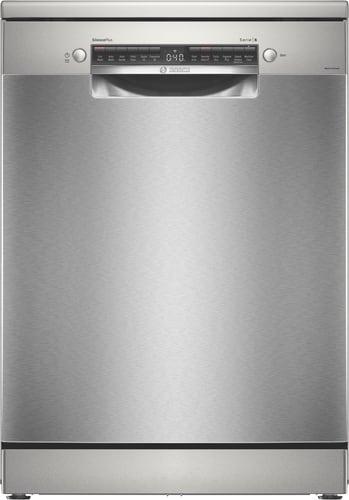
Four rungs, and the steps between them are small. Series 2 is 13 place settings at 48 decibels. Series 4 adds a place setting and drops to 46. Series 6 drops to 44 and brings the water rating up to 5 or 5.5 stars. Series 8 reaches 42 decibels and 4.5 energy stars, and costs roughly three times the Series 2.
Within Series 4 and Series 6 there are pairs of near-identical models separated by a hundred dollars and a basket detail, which is why the numbers on the door tell you less than the model code does. The Series 6 SMS6HCI02A is the fifteen-place version; the SMS6HAI02A is fourteen places and $150 less.
What runs across the whole range is AquaStop Plus leak protection, warranted for the life of the machine, a heat-exchanger drying system, and an 845mm cabinet.
What We Like:
- 845mm under a standard benchtop
- Lifetime AquaStop leak protection
- Four rungs to choose from
What We Don't Like:
- Fifteen places only from the Series 6 up
How the Fisher & Paykel range is built
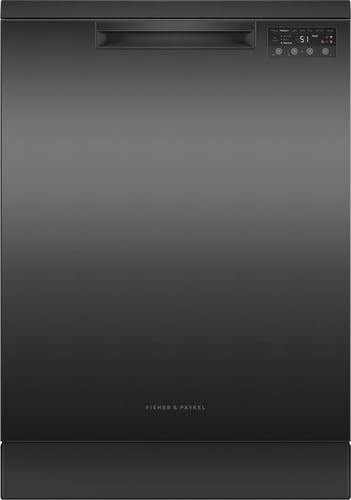
Two freestanding machines and a drawer. Series 5 is fifteen place settings at 48 decibels and 295kWh a year, which is the least efficient machine on this page. Series 7 keeps the fifteen places and transforms everything else: 42 decibels, 4.5 energy stars, 206kWh and 11.1 litres a cycle, at around $1,300.
That leaves an unusually wide gap between two rungs. There is no middle Fisher & Paykel, so the choice is the cheap one or the good one.
Both stand 895mm high, and both have the seven-program set. Leak protection is Aquastop plus flood protection rather than a lifetime-warranted system.
What We Like:
- Fifteen places from around $999
- 42dB and 206kWh around $1,300
- The DishDrawer has no Bosch equivalent
What We Don't Like:
- 895mm, with nothing shorter in the range
What actually differs
Height. Every Bosch here is 845mm and every freestanding Fisher & Paykel is 895mm. Australian benchtops sit at about 900mm, so the Fisher & Paykel fits with almost nothing to spare while the Bosch has 55mm of slack for an uneven floor or a thicker benchtop. Anyone replacing a machine in a fixed cabinet needs the measurement before settling on a brand, not just before settling on a model.
What a dollar buys. Fisher & Paykel front-loads capacity, with fifteen places from around $999. Bosch front-loads refinement: quieter running, better water ratings and a longer ladder, but you climb it to get capacity. At the top the two meet, with the Series 7 matching the Series 8's 42 decibels and 206kWh for half the money.
How many models there are. Bosch gives you five freestanding choices plus a 45cm; Fisher & Paykel gives you two. More rungs means a closer fit to a budget, and it also means a lot of near-duplicate codes that need looking up.
Leak protection. Bosch's AquaStop Plus is warranted for the life of the machine, which is the longest commitment either brand makes about anything. Fisher & Paykel's flood protection is covered by the same two-year warranty as the rest of the machine.
Service. Bosch's network in Australia is larger. Fisher & Paykel is a New Zealand brand with a long Australian presence and good regional coverage, but Bosch is easier to get serviced in most towns.
The drawer. Only Fisher & Paykel makes one, and there is no Bosch answer to it at any price.
The DishDrawer question
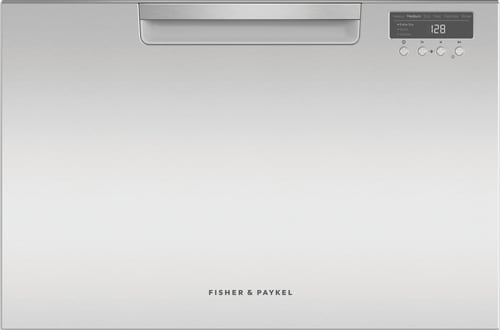
Fisher & Paykel's single DishDrawer is a dishwasher in a drawer at around $1,530. It suits a household of one or two, a butler's pantry, or a kitchen with no room for a full machine, and it runs a small load without the guilt of a half-empty 60cm machine. At 134kWh a year and 6.9 litres a cycle it uses less of both than anything else here.
The trade-offs are real and owners name them: it costs more than a full-size machine and holds seven place settings against fifteen, so a dinner party means running it twice. Double DishDrawer versions cost well over $2,000 and let two loads run on different programs.
Which brand suits which kitchen
Bosch suits a fixed cabinet where 50mm of clearance matters, a household that wants leak protection warranted for the life of the machine, and buyers who want to pick a precise rung anywhere from under $900 to premium territory.
Fisher & Paykel suits anyone who wants fifteen place settings without paying Series 6 money, a quiet and efficient machine at a mid-range price, or the drawer format that Bosch does not make.
FAQs
Is Fisher & Paykel still made in New Zealand?
The brand is New Zealand's and design work continues there, but manufacturing moved offshore, mostly to Thailand and China, after Haier acquired the company in 2012. Bosch's Australian dishwashers are made in Europe.
Why is the Fisher & Paykel Series 7 quieter than most of the Bosch range?
At 42 decibels it matches Bosch's own Series 8 and beats the Series 6 by two. Insulation and pump design account for most of the difference; there is no single feature that explains it.
What do the series numbers actually mean?
Within each brand they rank the machines, but they do not translate between brands and they do not translate between appliance types either. A Bosch Series 6 dishwasher and a Bosch Series 6 oven are not comparable positions, which is covered in Bosch series explained.
Does the DishDrawer clean as well as a full machine?
Owner reviews suggest yes for normal loads and less well for heavily soiled pans. The drawer is shallow, so the spray arm sits closer to the dishes and has less room to reach around a baked-on tray.
Which brand is cheaper to run?
It depends entirely on the model rather than the badge. The Fisher & Paykel Series 5 is the thirstiest machine here at 295kWh a year; the Series 7 and the Bosch Series 8 are the leanest at 206kWh. Across a year at 32 cents a kilowatt-hour that spread is about $28.