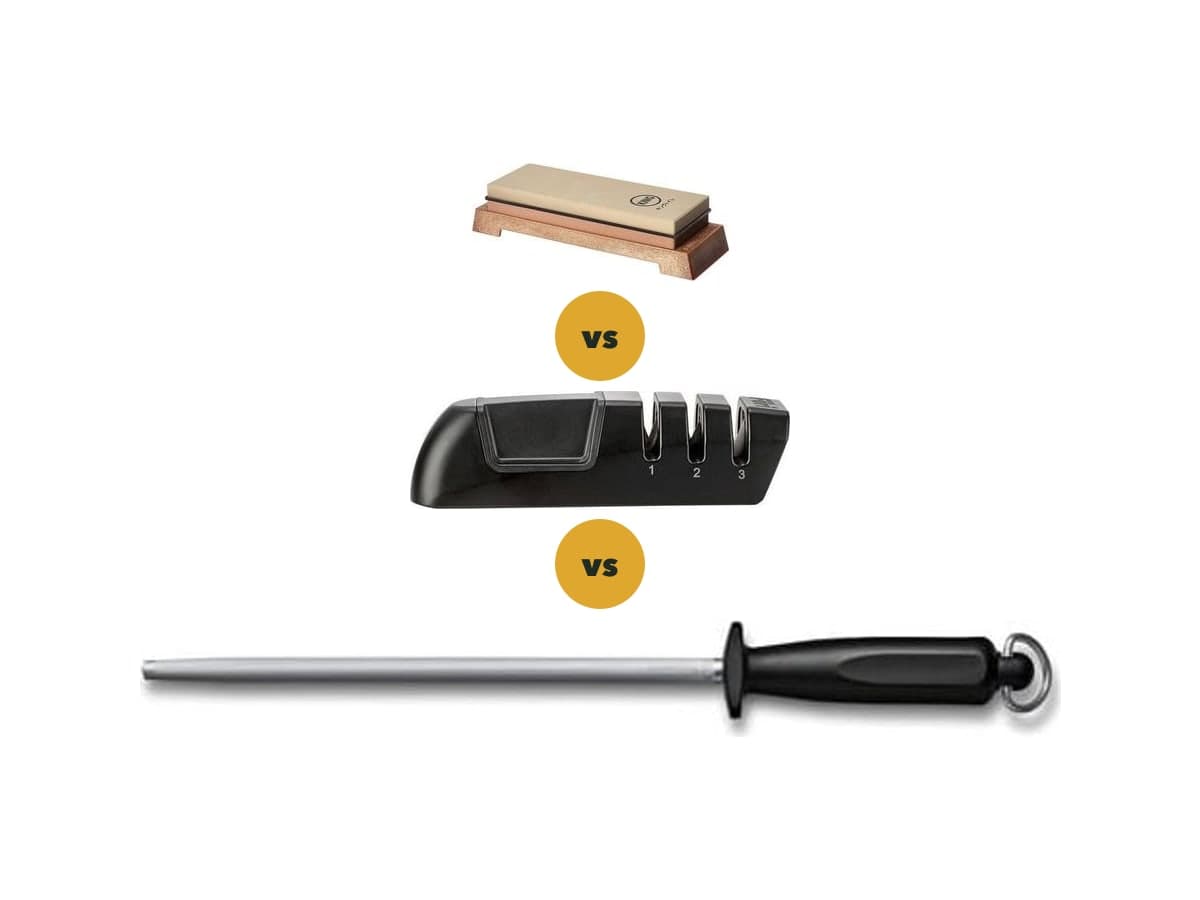
A whetstone and a pull-through sharpener both sharpen a knife, by grinding away a little metal to form a new edge. A honing rod does not sharpen. It pushes an edge that has bent out of line back into place, and Victorinox says honing takes off little or no metal.
Knife makers suggest honing often and sharpening a few times a year. Global puts it at honing weekly and sharpening two or three times a year with a whetstone or a pull-through sharpener. Following that advice takes a rod and one of the other two.
The three at a glance
| Whetstone | Pull-through sharpener | Honing rod | |
|---|---|---|---|
| What it does | Sharpens | Sharpens | Straightens the edge |
| Removes metal | Yes | Yes | Little or none |
| Angle | You hold it | Set by the slot | You hold it |
| Practice needed | Yes | No | Some |
| Example | King KW65, Under $50 | Furi Pro 3-Stage, Under $50 | Victorinox 7.8303, Under $50 |
Prices are from Amazon and Harris Scarfe, checked on 27 September 2026.
Whetstone
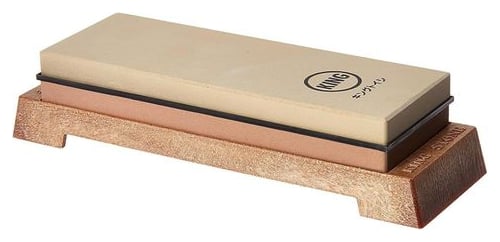
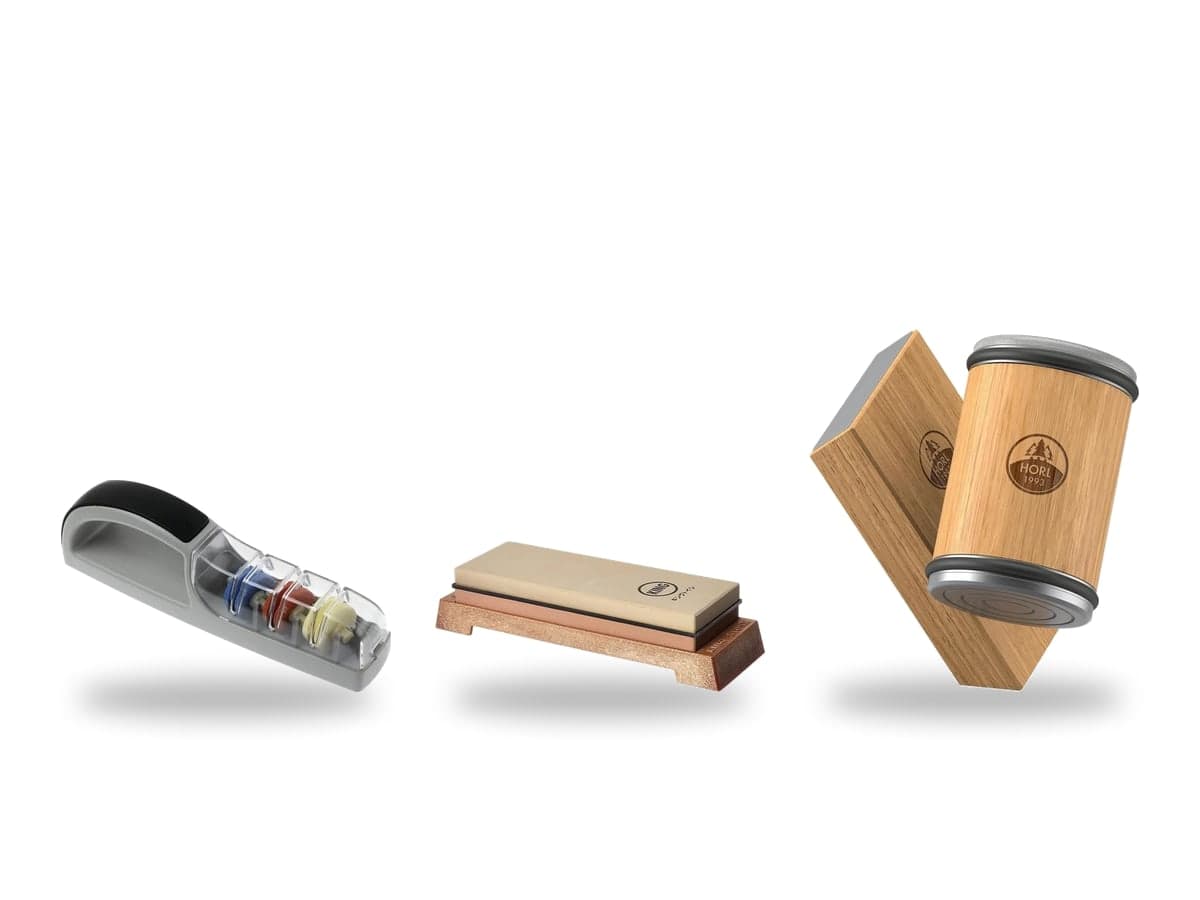
A whetstone is a flat abrasive block. You hold the blade against it at a steady angle and stroke the edge along it, then turn to the other side. The grit number says how coarse it is. A 1000-grit stone is the one used for general sharpening at home, and a 240-grit stone is for a blade that is chipped or very blunt, according to Global. A 6000-grit stone polishes the edge afterwards.
Water stones are soaked or wetted before use. For King's 1000/6000 combination stone, Korin says to soak only the 1000 side, for about two minutes, and splash water on the 6000 side; it warns that soaking the whole stone can make it split.
A whetstone gives the most control, since you choose the angle. It is also the slowest to learn. Shun recommends a whetstone, its own electric sharpener or a professional service for its knives. Global's advice for its knives is a whetstone or a water sharpener with ceramic wheels.
What We Like:
- You choose the angle
- Works on any straight edge
- Grits from repair to polish
What We Don't Like:
- Takes practice
- Needs soaking first
Pull-through sharpener
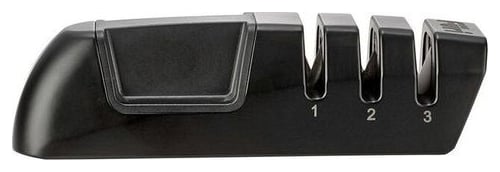
A pull-through sharpener has slots set at a fixed angle, and you draw the blade through each slot a few times. The Furi Pro 3-Stage has diamond-coated rods to prepare the edge, carbide to set the angle and ceramic rods to polish it, and it is calibrated to 26 degrees to match Furi's knives, according to Furi. Harris Scarfe lists a 25-year warranty.
Wheel sharpeners such as Global's MinoSharp 3 Plus work the same way, with ceramic wheels that turn in a water bath instead of fixed rods. Global sets its MinoSharp wheels to 15 degrees.
Knife makers sell pull-through sharpeners for their own knives, including Wüsthof, Furi and Shun. Wüsthof says hand-held pull-through sharpeners wear down with regular use. Global does not recommend electric sharpeners for its knives.
What We Like:
- No practice needed
- Sharpens in a few passes
- Small enough for a drawer
What We Don't Like:
- Fixed angle
- The abrasives wear down
Honing rod

A honing rod, often called a steel, is drawn along each side of the edge in turn to straighten it. Global suggests honing weekly, and Wüsthof says its steels can be used as often as after every use. Global describes its ceramic rod as a maintenance tool that will not sharpen a knife that is completely blunt or damaged.
A plain steel rod like the Victorinox is meant for stamped knives, whose steel is softer. For forged knives, which are harder, Victorinox recommends a diamond, tungsten carbide or ceramic rod. Mercer says ceramic hones better than metal and gives a smoother finish, and Wüsthof says a ceramic rod takes off a tiny amount of metal. Mercer's 25cm ceramic rod is one example.
What We Like:
- Keeps an edge working for longer
- Under $50
What We Don't Like:
- Does not fix a blunt knife
- Steel rods less suited to hard knives
What actually differs
What each removes. A whetstone and a pull-through sharpener grind metal away. A steel rod removes little or none, and a ceramic rod a tiny amount.
The angle. On a whetstone the angle is up to you on every stroke. A pull-through sharpener fixes it, at 26 degrees on the Furi and 15 on Global's MinoSharp. Wüsthof's standard edge is 14 degrees per side and Shun's is 16 degrees.
Knife type. Shun recommends a 6000-grit whetstone or a smooth hone for touching up its single-bevel blades, and Kai says its own pull-through sharpener is not designed for single-bevel blades. For serrated knives, Wüsthof advises a professional service, and Global tells owners of its G-9 bread knife not to sharpen it.
Which suits which cook
A whetstone suits cooks who want to choose the angle and are prepared to practise, and owners of single-bevel Japanese knives.
A pull-through sharpener suits cooks who want a sharp edge in a few passes without learning a technique.
A honing rod suits anyone who uses the same knife most days, between sharpenings with either of the other two.
FAQs
Is a whetstone better than a pull-through sharpener?
A whetstone gives more control over the angle and can repair chips with a coarse grit. A pull-through sharpener is quicker and needs no practice. Global lists both as ways to sharpen its knives.
Does a honing rod sharpen a knife?
No. A honing rod realigns the existing edge, and a knife that has gone blunt needs a whetstone or a sharpener.
What grit whetstone does a kitchen knife need?
Global says 1000 grit is the one most commonly used at home, for general sharpening. A 6000-grit stone polishes the edge afterwards, and a 240-grit stone repairs chips.
Do you have to soak a whetstone?
Water stones need soaking or wetting. For King's 1000/6000 combination stone, Korin says to soak only the 1000 side, for about two minutes.