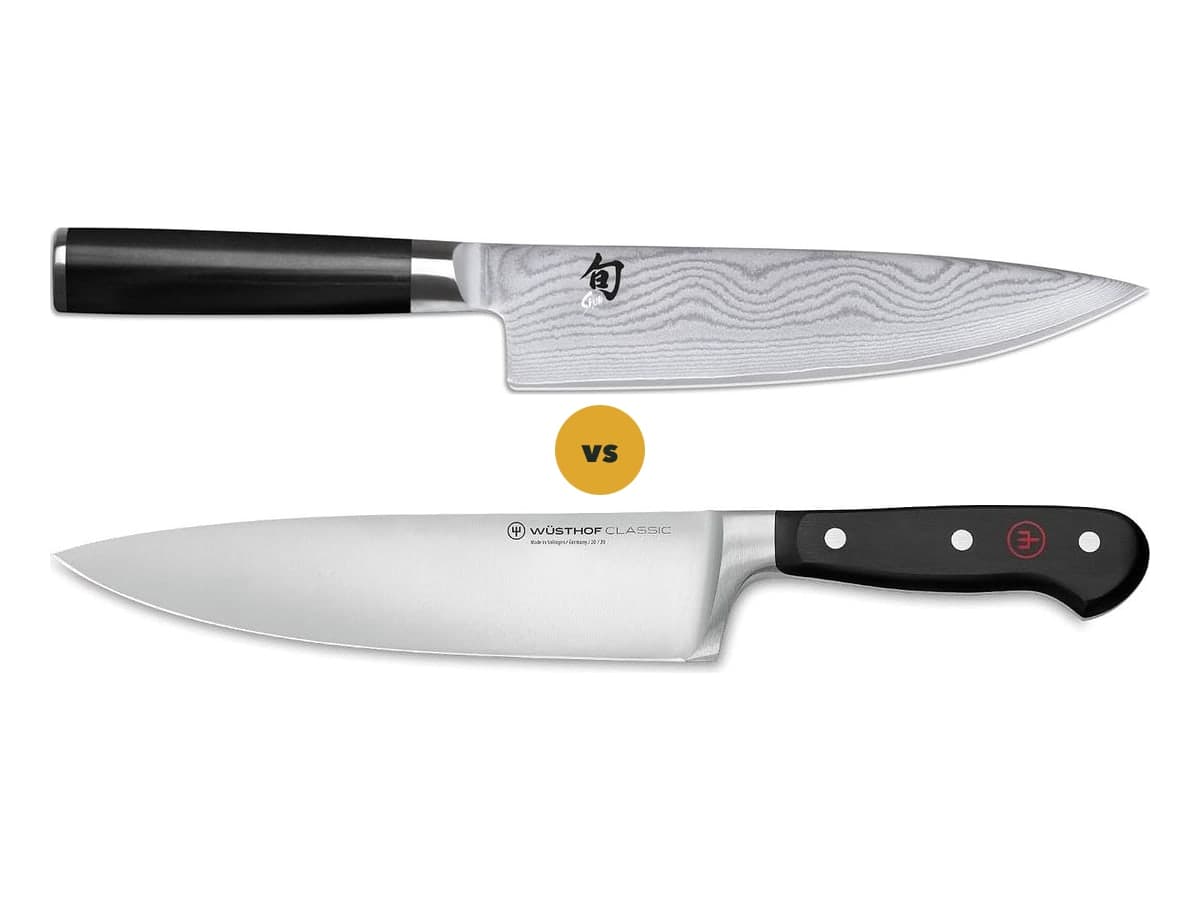
On the makers' own figures, the clearest difference between these Japanese and German chef's knives is weight, not hardness or sharpness. Global's G-2 is hardened to 56–58 Rockwell and Wüsthof's Classic to 58, and their edge angles are within a degree of each other. The Shun Classic is the Japanese knife here with markedly harder steel, at 60–61.
The differences that do hold across these knives are weight, the bolster and the handle. The German knife is the heaviest and has a full bolster; the Japanese knives are lighter and have no full bolster.
The makers' figures side by side
| Global G-2 | Shun Classic | Tojiro DP | Wüsthof Classic | |
|---|---|---|---|---|
| Made in | Japan | Japan | Japan | Germany |
| Blade | 20cm | 20cm | 18cm | 20cm |
| Steel | CROMOVA 18 | VG-MAX core | VG10 core | X50CrMoV15 |
| Hardness | 56–58 Rockwell | 60–61 Rockwell | Not published | 58 Rockwell |
| Edge angle | 15° | 16° each side | Not published | 14.5° |
| Weight | 170g | 190g | 185g | About 263g |
| Bolster | None | Not to the edge | Metal, not to the edge | Full, to the edge |
| Handle | Steel | Pakkawood | Laminate, riveted | Synthetic, riveted |
| Price | $50–100 | $150–200 | $100–150 | $150–200 |
Figures are from Global and its maker Yoshikin, Kai, Tojiro and Wüsthof. Wüsthof publishes no weight, so that figure is from a retailer's listing. Prices are Amazon's on 26 September 2026.
Hardness varies by knife, not country
Harder steel holds an edge longer and is more likely to chip; softer steel is tougher and quicker to sharpen. Among these four, the hardest is the Shun at 60–61 Rockwell, and chipping is the recurring complaint in its owner reviews. The Global and the Wüsthof sit at about the same 58. Hardness depends on the steel and heat treatment each maker chooses, not on the country.
Edge angles are similar
Wüsthof gives 14.5 degrees for the Classic and Kai sharpens the Shun to 16 degrees each side. Global calls the G-2's edge an acute 15 degrees without saying whether that is per side. On the figures the makers publish, the German edge is as fine as the Japanese ones.
Weight and the bolster
The Wüsthof weighs about 263g, against 170g to 190g for the Japanese knives. Its forged bolster, the thick collar where the blade meets the handle, adds to that weight and on the Classic runs down to the edge. It guards the fingers, and after years of sharpening it has to be ground back so the heel of the edge still meets the board.
The Global has no bolster, and the Shun's and the Tojiro's stop short of the edge. A heavier knife does more of the work through hard vegetables; a lighter one tires the wrist less.
Handles
Wüsthof's riveted synthetic handle and the Tojiro's riveted laminate handle are the traditional Western shape. The Shun's D-shaped Pakkawood handle and the Global's hollow steel handle are not. Handle comfort is a mixed point in Global's owner reviews and not a complaint for the others.
Warranty in Australia
The Wüsthof has a lifetime guarantee against defects, and the Shun a limited lifetime warranty for knives bought in Australia. Global's Australian warranty is two years. Tojiro publishes no warranty terms on its product pages.
The four knives

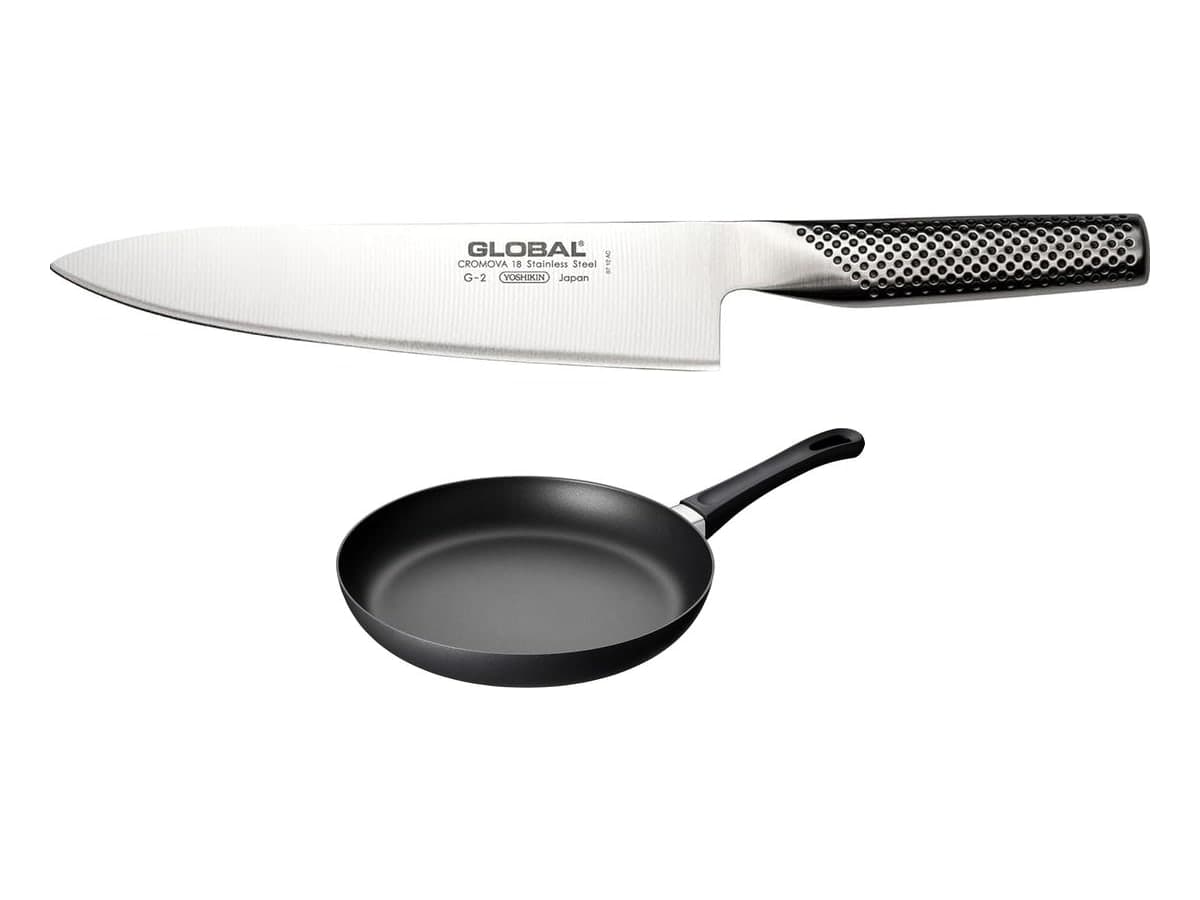
Global G-2. One piece of CROMOVA 18 steel with a hollow, sand-weighted handle, 170g. Its drawback is the two-year Australian warranty, and some owners find the steel handle uncomfortable. Compared in detail in Global vs Wüsthof.

Shun Classic. A VG-MAX core at 60–61 Rockwell with Damascus cladding and a Pakkawood handle, 190g. Chipping is the recurring complaint in its owner reviews. Compared in Global vs Shun.
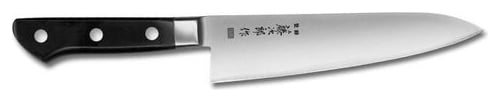
Tojiro DP 18cm. A VG10 core clad in stainless, with a metal bolster and a riveted laminate handle in the Western style, 185g. It is shorter than the others at 18cm, and Tojiro publishes no warranty terms.

Wüsthof Classic. Forged X50CrMoV15 at 58 Rockwell, with a full bolster and a riveted synthetic handle, about 263g. It costs the most of the four, and it is hand wash only.
Which suits which cook
A Japanese knife such as the Global or the Shun suits cooks who want a lighter knife and are happy to hand wash it and keep it away from bones and frozen food, especially the harder Shun.
A German knife such as the Wüsthof suits cooks who want more weight behind the blade, a traditional riveted handle and a full bolster, and a lifetime guarantee.
FAQs
Are Japanese knives sharper than German knives?
Not by the figures the makers publish for these knives. Wüsthof gives 14.5 degrees for the Classic, Global 15 degrees for the G-2 and Kai 16 degrees each side for the Shun.
Are Japanese knives harder?
Some are. The Shun, at 60–61 Rockwell, is harder than the Wüsthof's 58, but the Global matches the Wüsthof.
Why are German knives heavier?
The Wüsthof Classic is forged with a full bolster, which adds weight where the blade meets the handle. At about 263g it weighs at least a third more than the Japanese knives here.