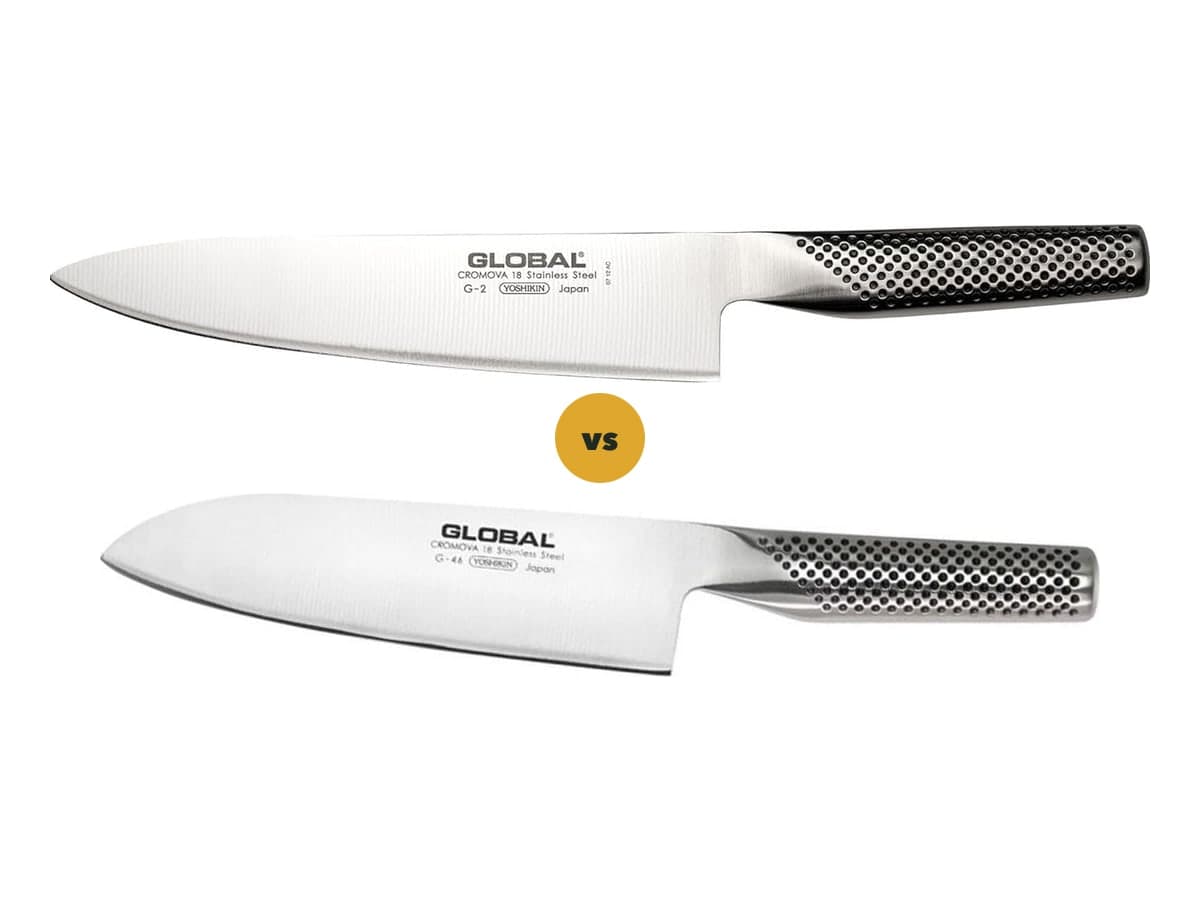
A chef's knife has a curved edge and a pointed tip, so it can rock back and forth through herbs and garlic without leaving the board. A santoku is shorter, with a flatter edge and a rounded tip, and suits a straight up-and-down chop or a forward push through vegetables.
Both handle most everyday jobs. The chef's knife is better for carving, point work and big pumpkins, and the shorter santoku is easier to control on a small board. Which suits you depends mostly on whether you rock the knife or chop straight down.
The two shapes at a glance
| Chef's knife | Santoku | |
|---|---|---|
| Usual length | 20cm | 17–18cm |
| Edge | Curved towards the tip | Flatter along most of its length |
| Tip | Pointed | Rounded, dropping down to meet the edge |
| Cutting motion | Rocking, slicing, point work | Straight chop, push cut, thin slicing |
| Carving a roast | Suited | Shorter blade, harder |
| Origin | European | Japanese |
How the shapes cut
The chef's knife. The curve in the front half of the edge lets the knife rock on the board, with the tip staying down while the heel lifts and falls. That is the motion for mincing herbs, garlic and shallots. The point does fine work, like scoring or trimming around a bone, and 20cm reaches across a big onion or a slab of pumpkin in one stroke.
The santoku. The edge is much flatter, so more of it meets the board at once and a straight-down chop cuts through without rocking. The rounded tip is less useful for point work. Many santokus have scallops ground along the side of the blade, meant to stop slices sticking to it.
The same knife in both shapes: Global G-2 and G-46
Global makes its cook's knife and its santoku from the same steel with the same handle, which makes the pair a direct comparison of shape alone.
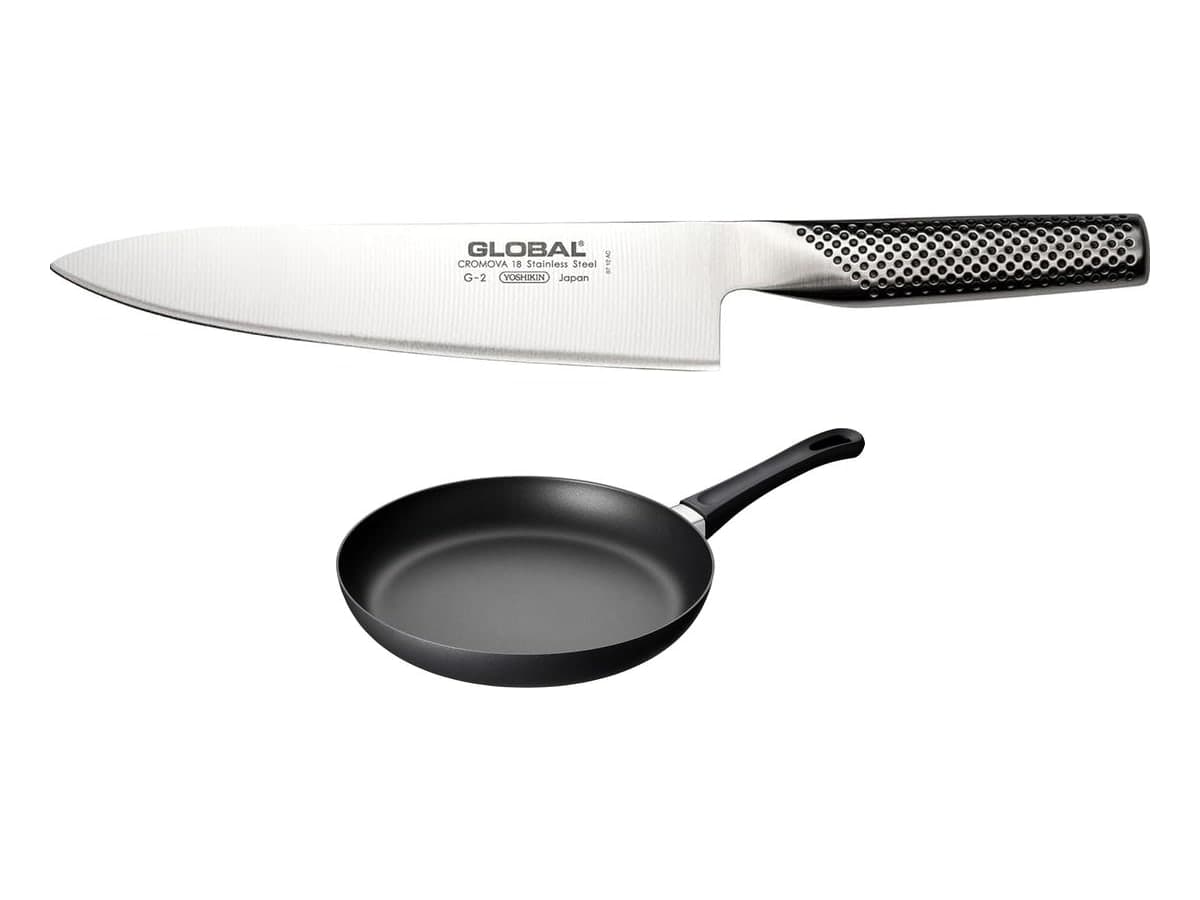
Global G-2 Cook's Knife 20cm

The G-2 is the 20cm chef's knife: CROMOVA 18 stainless steel at 56–58 Rockwell, with a hollow, sand-weighted handle, according to Global's Australian site. It is in the $50–100 range on Amazon. Owner reviews praise its sharpness and balance; some owners find the steel handle uncomfortable over long sessions.
What We Like:
- Rocks cleanly through herbs
- Long enough for carving
What We Don't Like:
- Some find the handle uncomfortable
Global G-46 Santoku 18cm
The G-46 is the 18cm santoku, 30cm long overall, in the same steel with the same handle. It is in the $50–100 range on Amazon. Owner reviews say it arrives very sharp; the reservations are the price and a few reports of a fragile blade.
What We Like:
- Flat edge for straight chopping
- Shorter and easier to control
What We Don't Like:
- A few owners report a fragile blade
Which suits which cook
A chef's knife suits cooks who rock-chop, carve roasts at the table, or break down big vegetables like pumpkin and cabbage.
A santoku suits cooks who chop straight down or push the blade forward, cook mostly vegetables, and find a 20cm blade unwieldy.
Our best chef's knives cover the 20cm shape from under $100 up, and the santoku versions of the Global and Furi knives are compared in Furi vs Global.
FAQs
What does santoku mean?
It translates as "three virtues" or "three uses". The three are explained either as slicing, dicing and mincing, or as meat, fish and vegetables.
Is a santoku good for meat?
It slices boneless meat and fish well. The shorter blade and rounded tip make it the weaker choice for carving a large roast or working around bones.
Can you rock a santoku?
A little. The flatter edge means only a short part of it rocks, so a santoku does its best work with a straight chop.