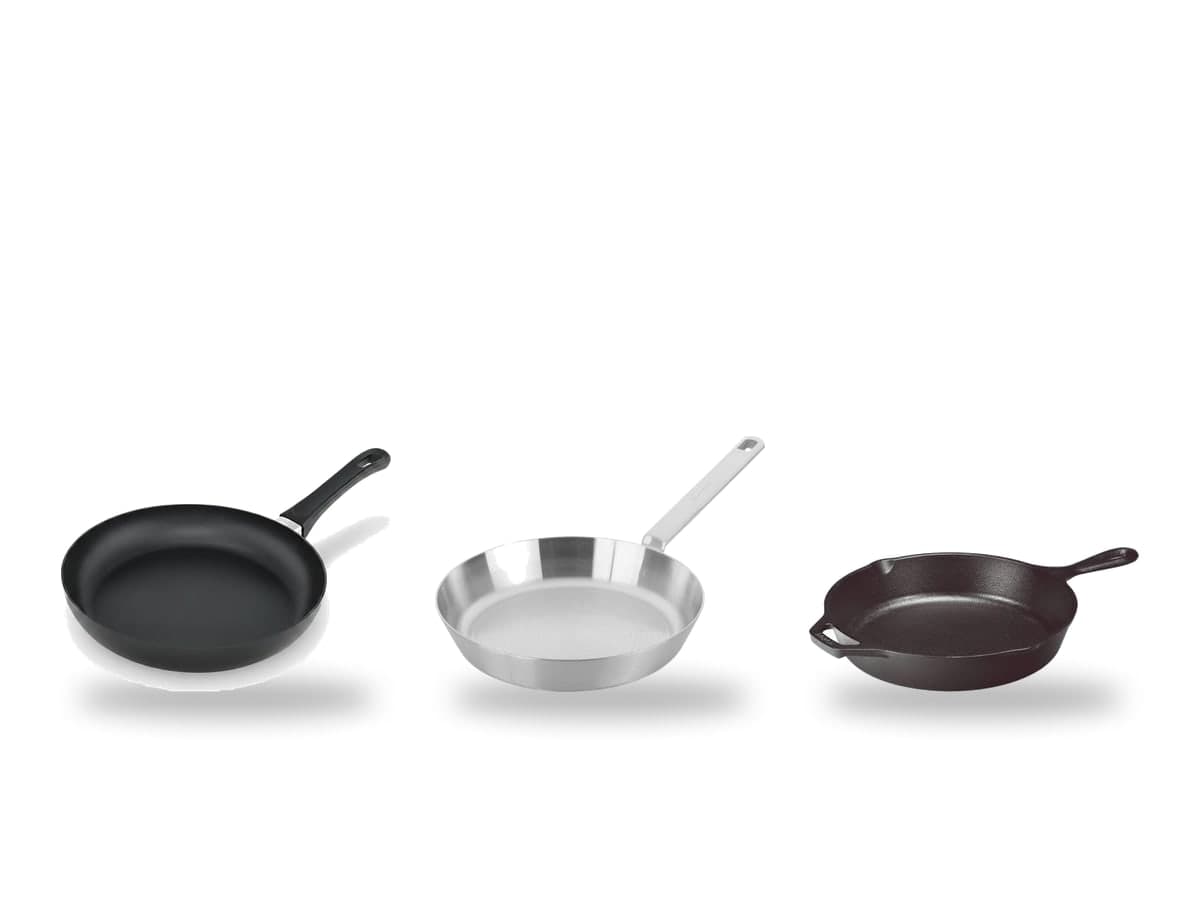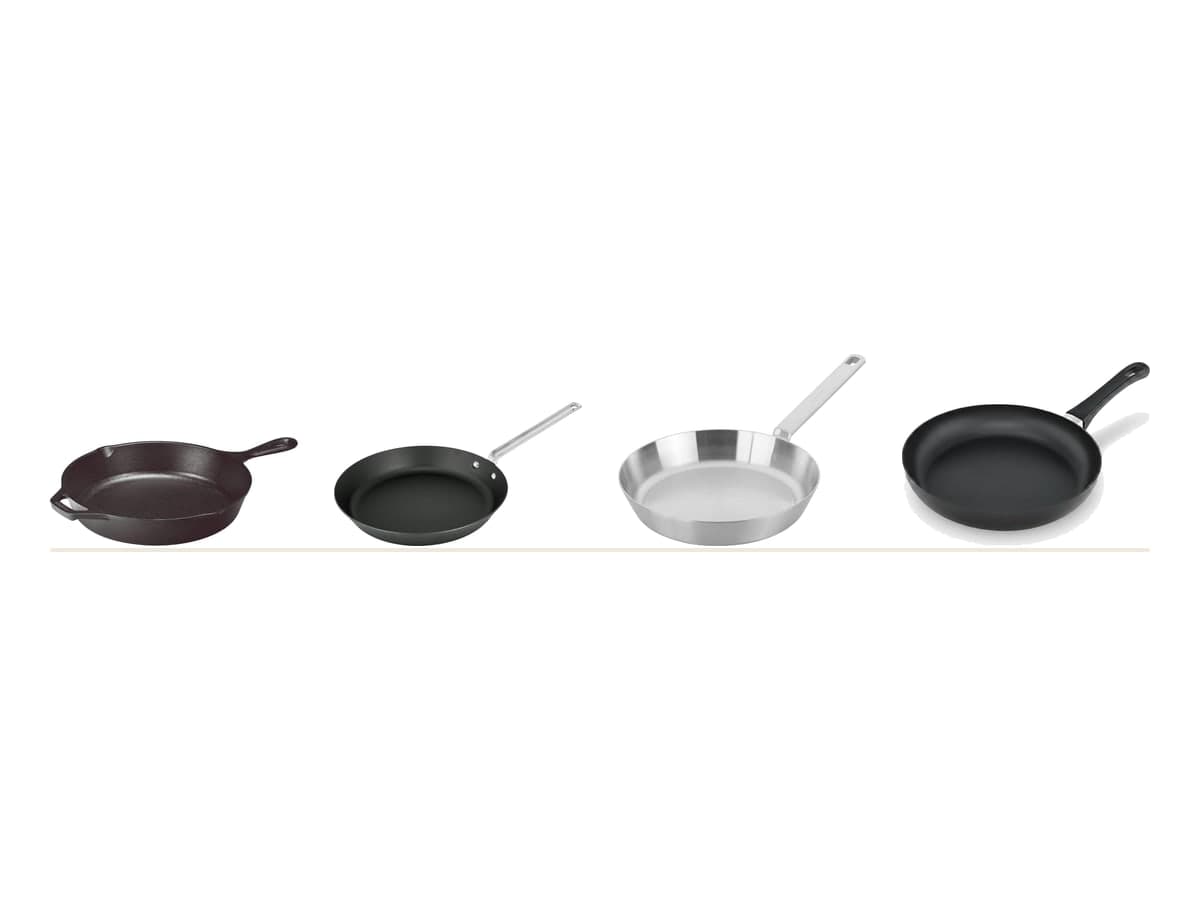
What a frying pan is made of decides how heavy it is, and how much work it takes to stop food sticking. Non-stick releases an egg with very little oil but has a coating that wears out. Cast iron and carbon steel have no coating; instead they are seasoned with oil baked onto the surface, which builds up the more they are cooked in, according to Lodge. Stainless steel has neither, and relies on preheating and oil.
The four at a glance
| Cast iron | Carbon steel | Stainless steel | Non-stick | |
|---|---|---|---|---|
| Example | Lodge 26cm | Scanpan Black Iron 30cm | Scanpan Elektra 28cm | Scanpan Classic 28cm |
| Surface | Seasoned | Seasoned | Bare steel | Coated |
| Induction | Yes | Yes | Yes | No (Classic Induction: yes) |
| Oven | Yes | Above 300°C | 250°C | 250°C |
| Dishwasher | No | No | Yes | Yes |
| Price | $50–100 | $100–150 | $50–100 | $100–150 |
Figures for the three Scanpan pans come from Scanpan's range chart; Scanpan rates the Elektra and Classic as dishwasher safe but recommends washing by hand. Lodge's are from the listing. Prices were read at Amazon and Harris Scarfe on 27 September 2026.
Cast iron
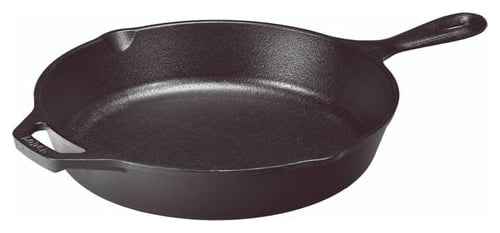
Lodge's 26cm skillet is cast in the USA and seasoned with vegetable oil at the foundry, so it can be used straight from the box. The listing rates it for induction cooktops, ovens, barbecues and campfires. Cast iron takes longer to heat up than carbon steel and holds its heat longer, according to de Buyer, which makes carbon steel pans.
It is washed by hand, dried and wiped with a little oil. Lodge says mild dish soap is fine, and that tomato or lemon in small amounts will not hurt a new pan, though long cooking of very acidic food can break down the seasoning. Owner reviews praise how it sears steak. The complaints are the weight, and some owners find the 26cm size smaller than they expected.
What We Like:
- Works on induction
- Oven, barbecue and campfire safe
- Seasoning builds with use
What We Don't Like:
- Heavy, say owners
- Smaller than some expect
Carbon steel
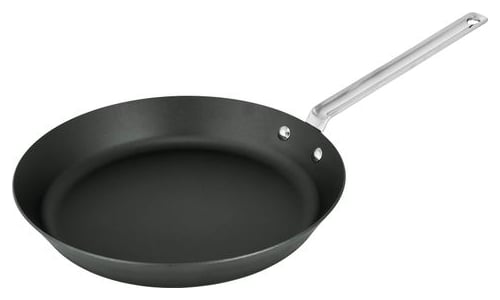
Carbon steel is seasoned like cast iron. Scanpan's Black Iron is spun from 2.5 to 3mm carbon steel, comes pre-seasoned, and is rated for induction and for ovens above 300°C. It is made in Taiwan. De Buyer says a cast iron pan can weigh twice as much as a carbon steel one.
Scanpan's listing calls for hand washing without detergent, which strips the seasoning, and for regular re-seasoning. De Buyer adds that even a little moisture can rust carbon steel, so the pan needs drying as soon as it is washed. There are few owner reviews of the Black Iron so far.
What We Like:
- Lighter than cast iron
- Oven-safe above 300°C
- Induction compatible
What We Don't Like:
- Needs regular re-seasoning
- Rusts if left wet
Stainless steel
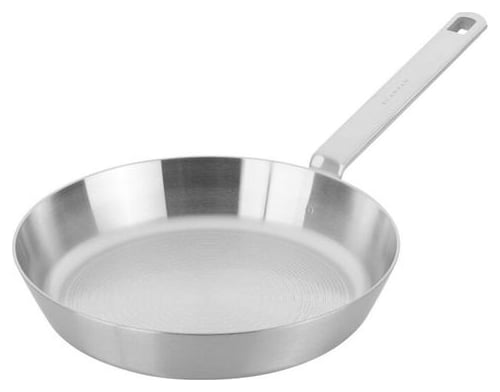
A stainless steel pan has no coating to wear out and no seasoning to look after. Stainless steel conducts heat about a sixteenth as well as aluminium, going by Engineering ToolBox's figures, so Scanpan's stainless pans carry aluminium or copper inside, either in the base or in layers up the sides. The Elektra is five-ply, with aluminium layers running up the sides, not just across the base. It suits induction cooktops, can go in a 250°C oven, and is rated for the dishwasher and metal utensils.
Food sticks to stainless unless the pan is heated before the food goes in and there is oil, butter or liquid in it, according to Essteele. Essteele also warns that long spells on high heat can leave a rainbow discolouration inside.
What We Like:
- Nothing to peel or season
- Layers run up the sides
- Dishwasher safe
What We Don't Like:
- Needs a hot pan and oil
- High heat can discolour it
Non-stick
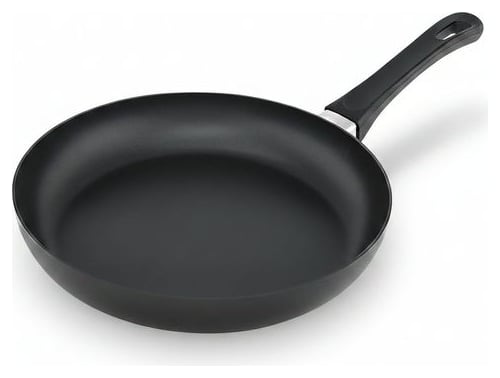
Scanpan's Classic has its Stratanium non-stick coating on a body of cast recycled aluminium, made in Denmark. It goes in the oven to 250°C and Scanpan rates it safe with metal utensils. It won't work on an induction cooktop, but the Classic Induction will. Scanpan's chart describes only its Stratanium Leap coating, used on the Sava and Nura ranges, as PFAS-free. Owner reviews rate the Classic's non-stick highly. The complaints are about durability, with some reporting a broken handle or a chipped coating.
For PTFE non-stick coatings, Germany's Federal Institute for Risk Assessment expects no health effects when a pan is used as intended. An overheated coating can give off harmful gases at 360°C, it says, so a coated pan should never be heated empty. The Singapore Food Agency advises replacing a pan once the coating is badly scratched, peeling, flaking or chipped.
What We Like:
- Releases food with little oil
- Rated for metal utensils
- Oven-safe to 250°C
What We Don't Like:
- Not for induction cooktops
- Handle and coating complaints
What actually differs
Weight. Cast iron is heavy, and de Buyer says a cast iron pan can weigh twice as much as a carbon steel one.
Sticking. Non-stick releases food with little oil from the first use. Cast iron and carbon steel release better as the seasoning builds. Stainless needs a hot pan and oil every time.
Care. Stainless and the Scanpan non-stick can go in the dishwasher. Cast iron and carbon steel are washed by hand, dried and oiled, and Lodge and de Buyer both warn that acidic food cooked for a long time wears the seasoning.
Induction. Cast iron and carbon steel work on induction, and so does every stainless range on Scanpan's chart. An aluminium non-stick pan works only if it is made for induction, as the Classic Induction is and the Classic is not. The ACT Government suggests testing with a magnet. If it sticks to the base, the pan should work on induction.
Lifespan. Non-stick is the only one of the four with a coating that wears out.
Which suits which cook
Non-stick suits eggs, fish and pancakes, and cooks who want the easiest washing up. It is the one to keep off high heat.
Cast iron suits searing and dishes that go from the stove to the oven, for cooks who don't mind the weight.
Carbon steel suits high-heat searing and stir-frying in a lighter pan, for cooks willing to season and dry it.
Stainless steel suits browning meat and making a pan sauce from what sticks, for cooks who want a pan that can go in the dishwasher and be scraped with metal.
FAQs
Is carbon steel better than cast iron?
Neither is better at everything. Carbon steel is lighter and heats up and cools down faster, according to de Buyer. Cast iron holds its heat longer. Both need seasoning.
Are non-stick pans safe?
The German Federal Institute for Risk Assessment does not expect health effects from PTFE non-stick coatings used as intended. The risk comes from overheating. It says a coating can release harmful gases at 360°C, and that a coated pan should never be heated empty.
Can you use soap on cast iron?
Yes. Lodge says mild dish soap is fine on its seasoned cast iron.
Why does food stick to a stainless steel pan?
Stainless steel has no non-stick surface, so the pan needs heat and fat. Essteele says to heat the pan before adding food and to use oil, butter or liquid.
How do you tell if a pan works on induction?
Hold a magnet to the base. If it sticks, the pan should work on induction, according to the ACT Government.